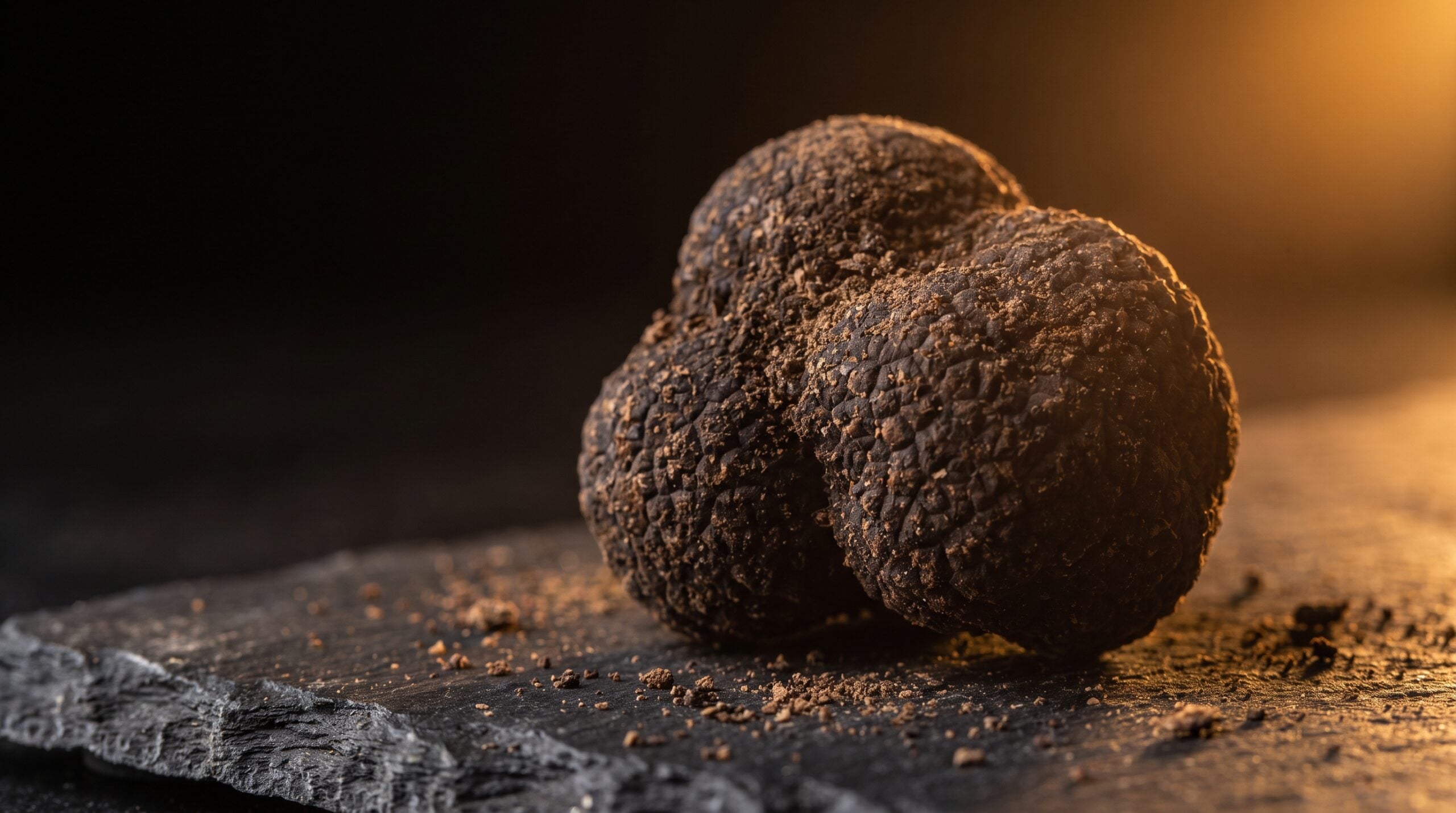
Where do truffles come from? The prized black winter truffle comes from Spain more than anywhere else. Spain is the world’s leading producer of black truffle, about 120 tonnes in 2022, three times France and four times Italy, and roughly 80% of Spain’s black truffle comes from one area of Teruel province in eastern Spain, AFP reported in December 2023. The trailer for the documentary Truffle Town puts it more boldly: “Over 70% of truffles worldwide come from Spain. And this little town is responsible for the majority.” That is the film’s line, not a measured statistic. Here is how the world’s most secretive ingredient actually gets from the dirt to your plate.
Truffle types, seasons, and where they grow
| Truffle | Species | Season | Where it grows |
|---|---|---|---|
| Black winter truffle (“black diamond”) | Tuber melanosporum | Roughly November–March | Spain, France, Italy; cultivated in Australia and the U.S. |
| Summer truffle | Tuber aestivum | Roughly May–August | Widespread across Europe |
| Burgundy truffle | Tuber uncinatum | Autumn | France and central Europe |
| White truffle | Tuber magnatum | Roughly October–December | Northern and central Italy, parts of the Balkans; famously resistant to cultivation |
What a truffle actually is
A truffle is the underground fruiting body of a fungus that lives in symbiosis with tree roots. The fungus trades nutrients with its host tree, and the truffle is how it reproduces — releasing an aroma powerful enough to recruit animals to dig it up and spread its spores.
- Host trees: mainly oaks and hazels, plus poplars and pines for some species
- Soil: rocky, alkaline, calcareous ground — land that looks almost worthless at first glance
- Climate: Mediterranean rhythms — wet springs, hot summers, cool harvest seasons
- Depth: underground, usually near the surface but invisible from above
Where truffles grow around the world
Spain — the quiet giant
Spain leads global black-truffle production, and most of it comes from rocky, once-uncultivated hill country in Teruel province, where irrigation and inoculated oak plantations drove the boom, according to AFP. Yet the region behind that dominance is barely known outside the trade — a secrecy that Truffle Town treats as its central mystery. The film follows one family and their dogs through a full season; the town stays unnamed until the premiere.
France and Italy — the famous names
Périgord black truffles and Alba white truffles carry centuries of prestige, and much of the world’s truffle romance was written there. By volume, though, Spain now outproduces both, on AFP’s figures. The film’s trailer suggests why that is so little known: “If you don’t know where it comes from, you sell it as if it were yours, and you control the price.”
The new world of cultivation
- Australia grows black truffle in the southern hemisphere, harvesting in the opposite season
- Growers in the United States have planted truffle orchards as well
- Inoculated seedlings made cultivation possible — but growers still wait years for a first truffle; in Spain, trees only begin to produce after about 10 years, AFP reported
- White truffle is the holdout: the first Tuber magnatum grown in an orchard outside its natural range, a handful of truffles from one French orchard, was harvested only in 2019 (Bach et al., Mycorrhiza, 2021)
How truffles are found: the dogs
Ripe truffles announce themselves only by scent, so every harvest still comes down to a trained nose. Pigs were the traditional hunters, but they tend to eat the find. Dogs took over: Italy’s national truffle law of 1985 requires licensed hunters to search “con l’ausilio del cane a ciò addestrato,” with the help of a dog trained for the job (Law 752/1985, art. 3).
- A dog catches the aroma rising through the soil and marks the spot
- The hunter digs carefully by hand, protecting the fungal network for next season
- The truffle is graded by size, ripeness, and species — then races the clock to market
“Can’t have a great story without a dog,” as the trailer says — and no truffle harvest without one either.
Why truffles cost so much
Top black truffles can fetch up to €1,500 a kilogram, AFP reported. The reasons:
- Time: orchards take years to produce; wild grounds produce on their own schedule
- Scarcity: yields swing hard with weather, and every truffle is found individually
- Perishability: a fresh truffle loses its aroma quickly after harvest — there is no warehouse strategy
- Labor: a person and a dog, walking the land, one find at a time
- Opacity: layers of brokers between the hunter and the restaurant, each adding margin
The trailer’s version of the math is blunt: “By the time it gets to a 3 star Michelin restaurant, the price has multiplied 15 times.” That is the film’s claim.
The fraud problem
The truffle trade’s secrecy has a cost: it makes fraud easy. Cheaper species get sold as premium ones: a Spanish study of 51 truffle products found that 22% used lower-value truffles (T. aestivum and T. indicum) while their labels referred to “truffles” or T. melanosporum, and only 20% were correctly labeled (Tejedor-Calvo et al., Food Control, 2023). The best-known trick sits in supermarket aisles everywhere — truffle oil, which usually contains no truffle at all, just a manufactured version of one truffle aroma compound (see what is actually in truffle oil). If you have ever ordered truffle fries, you may well have tasted the imitation, not the fungus.
See where it all begins
Truffle Town premieres Friday, October 16, 2026, exclusively on the 210 Digital channel for Apple TV, iPhone, and iPad. The official 4K trailer is free now, and the film can be preordered for $14.99 — 40% under its premiere price. Truffle Town is a 210 Digital original; 210 Digital is the streaming channel of 210 Digital Marketing, which also offers video production for healthcare organizations.
- Watch the free trailer and preorder Truffle Town
- The complete premiere and pricing guide
- The story of the 210 Digital channel
Truffle FAQ
Where do most of the world’s truffles come from?
Spain is the world’s leading producer of black truffle: about 120 tonnes in 2022, three times France and four times Italy, with roughly 80% of Spain’s harvest from one area of Teruel province in eastern Spain (AFP, December 2023). The documentary Truffle Town calls its unnamed Spanish town the truffle capital of the world.
Why are truffles so expensive?
Truffles resist farming shortcuts: they grow underground on tree roots, take years to appear, last only days once harvested, and must be found by trained dogs one at a time. Layered middlemen and widespread mislabeling push retail prices higher still.
Can truffles be farmed?
Yes. Modern truffle orchards plant oak and hazel seedlings inoculated with truffle fungus, but growers typically wait years for a first harvest, and results are never guaranteed — one reason cultivated supply hasn’t crushed prices.
Is truffle oil made from real truffles?
Most commercial truffle oil contains no truffle at all — its aroma usually comes from a manufactured version of 2,4-dithiapentane, a compound that real white truffles also contain. It’s one of the food industry’s most successful sleights of hand, and part of the fraud story Truffle Town digs into.
Sources
- Bontemps V. “Black truffle production booms in Spain.” AFP, via Phys.org, December 15, 2023. phys.org
- Tejedor-Calvo E, et al. “Truffle flavored commercial products veracity and sensory analysis from truffle and non-truffle consumers.” Food Control 2023, 145:109424. DOI 10.1016/j.foodcont.2022.109424
- Bach C, et al. “First production of Italian white truffle (Tuber magnatum Pico) ascocarps in an orchard outside its natural range distribution in France.” Mycorrhiza 2021, 31:383–388. DOI 10.1007/s00572-020-01013-2
- Italy, Legge 16 dicembre 1985, n. 752 (truffle harvesting, cultivation and trade), art. 3. Normattiva
Related Reading
- About 210 Digital Marketing
- Podcast Production Company
- Healthcare’s Zero-Click Reality: Winning AI Overviews in 2026
- Your Website Traffic Is Up But Leads Are Crashing — Here’s How AI Broke Your Sales Funnel (And How to Fix It)
How we research and fact-check: every statistic links to its source. Read our editorial standards.