The Great Disconnect: Why Your Website Traffic Is Climbing While Leads and Revenue Are Falling Off a Cliff
You’re staring at your Google Analytics dashboard and the numbers don’t lie — website traffic is steady or even trending upward. But here’s the gut punch: your phone isn’t ringing. Form submissions are down. New patient appointments have flatlined. Revenue is slipping.
You’re not imagining it. And you’re definitely not alone.
Plenty of healthcare organizations — from private practices and dental offices to behavioral health centers and med spas — are seeing some version of this pattern. The visitors are there, but they’re not converting. A big part of the explanation: AI has changed how people find, evaluate, and choose healthcare providers — and many practices are still working from an older playbook.
Let’s break down what’s actually happening, why it matters for your practice, and what you can do about it.
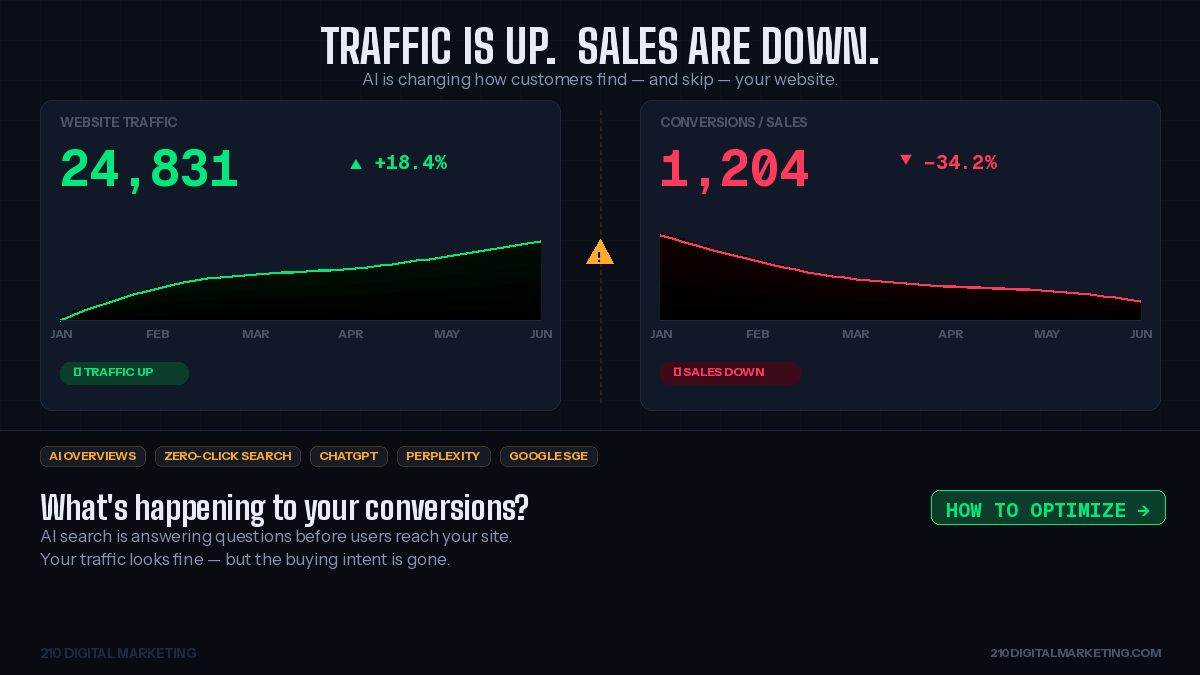
Illustration, not client data. Traffic can look steady while AI Overviews, ChatGPT, and zero-click search answer questions before visitors ever reach your site.
The AI Revolution Already Happened — You Just Didn’t Get the Memo
Here’s the reality check. In February 2024, Gartner predicted traditional search engine volume would drop 25% by 2026 as consumers shift to AI chatbots and other virtual agents. Google tells a different story about volume: in July 2026 it said AI Mode is driving an incremental increase in Search queries overall. The real change is what happens on the results page. In Pew Research Center’s analysis of March 2025 browsing data, 18% of Google searches produced an AI summary, and people who saw one clicked a traditional result on 8% of visits, compared with 15% when no summary appeared. Seer Interactive, which tracks click-through rates across its clients’ queries, found that organic CTR on queries with an AI Overview fell 61% between June 2024 and September 2025; its 2026 update reported a partial rebound early this year, so treat any single figure as a snapshot.
Meanwhile, SparkToro’s analysis of Similarweb’s U.S. clickstream panel found that 68% of Google searches in the first four months of 2026 ended without a single click, up from about 60% in 2024 — a phenomenon known as “zero-click search.” Publishers feel it too: across more than 2,500 news sites tracked by Chartbeat, Google organic search traffic fell by a third between November 2024 and November 2025, though the Reuters Institute notes it is not clear how much of that is down to AI Overviews.
So why does your traffic look okay? Because Google is still serving your pages as impressions. People see your site in results. AI Overviews may even reference your content. But increasingly, users are getting their answers without ever visiting your website. They read the AI-generated summary, get what they need, and move on — never filling out your contact form or picking up the phone.
It’s Not Just Google Anymore: The Rise of AI Chatbots as Search Engines
Here’s where it gets even more disruptive. Patients aren’t just Googling their symptoms or searching “best dentist near me” the old-fashioned way. They’re asking ChatGPT, Claude, Perplexity, and Gemini. In a February 2026 Pew Research Center survey, one in five U.S. adults said they use AI chatbots to get medical advice (more on where that is heading in our look at the future of chatbots in healthcare). Each of these platforms delivers information differently.
ChatGPT is the most widely used. OpenAI reported more than 900 million weekly active users in March 2026, and Pew found 44% of U.S. adults use it. It has added agent mode, which can browse and complete tasks for the user, and Instant Checkout for shopping, so more questions end in an action inside ChatGPT. Think about that: a potential patient can ask ChatGPT for the best-reviewed addiction treatment center in San Diego and get a synthesized answer — with or without linking to your site.
Claude (made by Anthropic) can search the web and cite its sources in its answers. If your pages aren’t clear and credible enough to be cited, a competitor’s will be.
Perplexity is built around real-time source citations — meaning if your content is authoritative enough to be cited, you get visibility. If it’s not, someone else does.
Gemini (Google’s own AI) has 950 million monthly active users, according to Google’s July 2026 earnings remarks, and is deeply integrated into Google’s ecosystem. It presents answers conversationally rather than as a list of links.
The critical difference between traditional search and these chatbots? Traditional search gives you ten blue links and lets the user choose. AI chatbots give one synthesized answer — and if your practice isn’t part of that answer, you’re not in the conversation.
Why Healthcare Practices Are Getting Hit Especially Hard
Healthcare sits in a uniquely vulnerable position. Most practice websites are built around informational content — blog posts about symptoms, treatment options, FAQs about insurance. This is exactly the type of content AI Overviews and chatbots are best at summarizing and serving directly to users.
Many health searches are phrased as questions, and Pew found that searches phrased as questions or full sentences were more likely to produce one. When someone searches “signs of alcohol withdrawal” or “do I need a root canal,” Google’s AI often answers right at the top — sometimes drawing on your content — and fewer people click through to your site.
For healthcare providers who built their entire patient acquisition strategy around SEO and organic traffic, this is a serious problem. Fewer top-of-funnel touches mean fewer opportunities to capture attention, build trust, and move prospects into your pipeline.
There is a partial offset. Google says people who reach a site from its generative AI features may be more inclined to engage, spend more time with your content, or convert. Check that in your own analytics and attribution before planning around it. The problem is there are fewer of these visitors, so each one matters more.
How to Optimize Your Healthcare Practice for the AI-Driven Search Landscape
The old playbook — publish content, optimize keywords, wait for Google to deliver patients — is delivering diminishing returns. Here’s what actually works in 2026:
1. Structure Your Content for AI Citation
Google’s guidance for its AI features stresses well-organized pages with clear headings, content that shows real expertise, and pages that are indexed and eligible to show with a snippet. Structured data isn’t required for AI features, but it still describes your pages accurately. Implement FAQ schema, medical condition schema, and local business schema across your site. Write for people first, per Google’s people-first helpful-content guidance; that is the content its AI features draw on.
2. Prioritize E-E-A-T (Experience, Expertise, Authoritativeness, Trustworthiness)
Understanding what EEAT means in AI search and the new rules for getting found is critical.
Google says its systems give even more weight to strong E-E-A-T on health topics. Include author bios with credentials, cite peer-reviewed sources, link to government health agencies like the CDC, NIH, and HHS, and make your clinical expertise unmistakably clear.
3. Build a Multi-Channel Presence
Don’t let one channel carry the practice. There is no universal ideal mix, so set targets from your own data, but most practices benefit from spreading patient acquisition across organic search, paid media, email, referrals, and social — and from diversifying into YouTube, community partnerships, and even podcast appearances. For a deeper dive, read our guide on how to choose a healthcare digital marketing company.
4. Optimize for Conversational Queries
People talk to AI differently than they type into Google. They ask full questions: “What’s the best rehab center in California that accepts Blue Cross?” Answer the real questions your patients ask, in plain language. You don’t need a separate page for every phrasing: Google says its AI systems understand synonyms, and mass-producing variants to manipulate results violates its scaled content abuse policy.
5. Track AI Visibility — Not Just Rankings
Traditional rank tracking isn’t enough. You need to know whether ChatGPT, Perplexity, Claude, and Google’s AI features are citing your practice. Start with the free first-party reports: Search Console’s generative AI performance reports, now available to all sites, and Bing Webmaster Tools’ AI Performance report, which shows when Copilot and Bing’s AI summaries cite your pages. Third-party trackers and manual testing can fill gaps, but Google cautions that no third-party tool has access to its internal ranking or AI systems. Being cited matters: Seer Interactive found that brands cited in an AI Overview earned 35% more organic clicks and 91% more paid clicks than brands that were not.
6. Invest in Bilingual and Culturally Relevant Content
Here’s an advantage many practices overlook: language. Hispanic Americans numbered 70.1 million as of July 1, 2025, 21% of the U.S. population, according to the U.S. Census Bureau, yet many practice websites and ad programs run in English only. Spanish-language content and campaigns may face less competition in your market; check keyword costs and competition locally rather than trusting a national average. Our look at the Hispanic healthcare marketing blind spot goes deeper.
The Bottom Line: Adapt Now or Get Left Behind
The healthcare practices that thrive in 2026 and beyond won’t be the ones clinging to yesterday’s SEO playbook. They’ll be the ones who recognize that the game has fundamentally changed — and who are building strategies around AI citation, multi-channel visibility, genuine clinical authority, and underserved market opportunities.
Many competitors are still wondering why their leads are drying up. The practices that adapt early — restructuring content for AI, diversifying traffic sources, and investing in bilingual patient acquisition — will separate from the pack.
If your traffic numbers look fine but your revenue tells a different story, it’s time for a strategic reset. At 210 Digital Marketing, we have worked only in healthcare since 2005, and we help practices navigate exactly this transition — from outdated SEO dependency to AI-optimized, multicultural growth strategies that actually generate patients, not just pageviews. We value your trust and transparency — you can review our privacy policy at any time.
Schedule a consultation and let’s diagnose what’s really happening with your digital presence — before AI makes the decision for your patients.
By Jace A.
Related Reading on AI in Healthcare
This topic connects to other deep dives we’ve published on AI in healthcare. If you found this piece useful, you may also want:
- How AI is used in healthcare
- How healthcare organizations can win AI Overviews
- How to get your medical practice recommended by AI
- What E-E-A-T means in AI search
- 210’s AI capabilities for healthcare
- Case studies
Related Reading
- AI and Search: Should I Be Concerned About SearchGPT and AI Overviews?
- How Do I Use AI for Marketing? A Practical Guide for Healthcare Teams
How we research and fact-check: every statistic links to its source. Read our editorial standards.