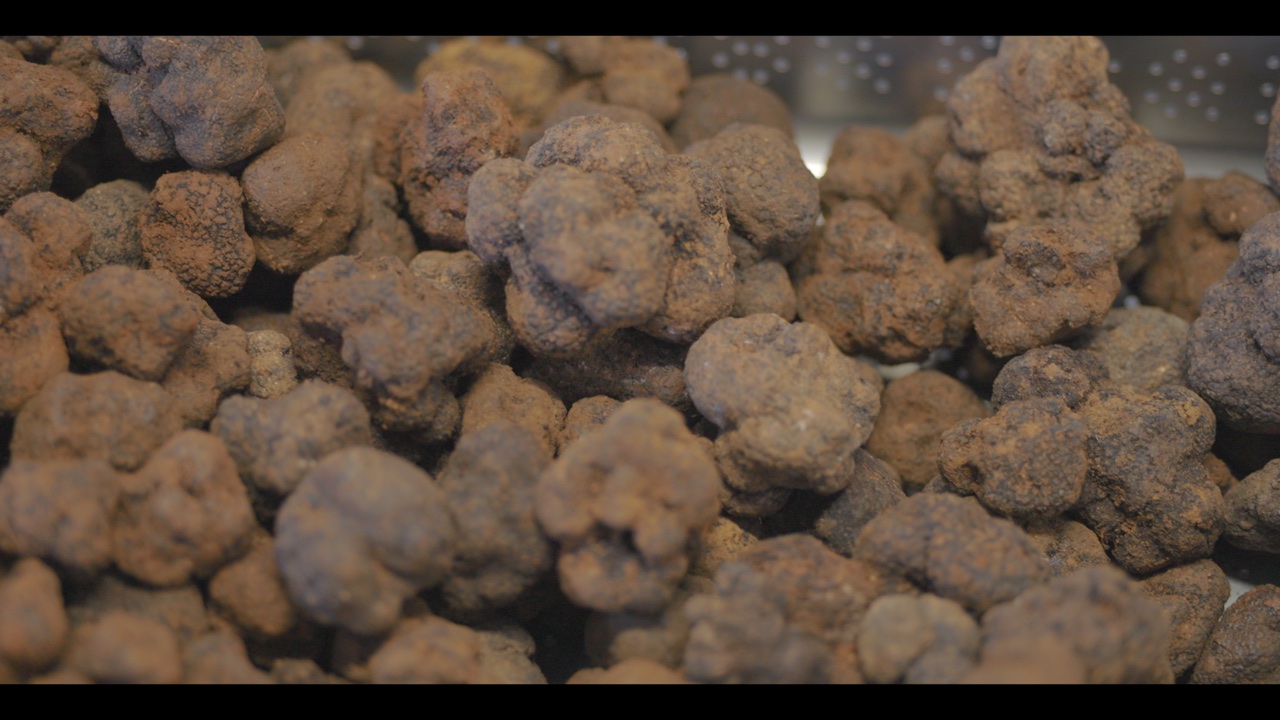
Most truffle oil has never touched a truffle. That much is true, and it is the reason chefs have spent twenty years complaining about it.
But the explanation you have probably read — that truffle oil is flavoured with a chemical that doesn’t exist in nature — is false. It is the most repeated claim on this subject and the easiest one to disprove, because the compound was first isolated from a truffle, in 1967.
The real story is stranger, and worse for the industry.
The short answer
The dominant flavouring in commercial truffle oil is bis(methylsulfanyl)methane, better known as 2,4-dithiapentane (CAS 1618-26-4). It is a genuine truffle compound: researchers measured it at 237 to 4,360 micrograms per kilogram in authenticated Italian white truffles. What makes most truffle oil synthetic is not that the molecule is fake — it is that the molecule is all there is, produced in a factory rather than extracted from a fungus, and standing in for an aroma that in nature runs to dozens of compounds at once.
What the compound actually is
| Name | Bis(methylsulfanyl)methane · 2,4-dithiapentane |
| CAS | 1618-26-4 |
| PubChem CID | 15380 |
| Formula | C3H8S2 (108.23 g/mol) |
| First identified | 1967, from white truffle (Tuber magnatum) |
| US status | FEMA GRAS No. 3878 |
| EU status | FL-no 12.118 |
| Safety | JECFA: “No safety concern at current levels of intake when used as a flavouring agent” |
Two corrections to things you will read elsewhere. It is not “FDA-approved” — the compound appears in neither 21 CFR 172.515 nor 21 CFR 182.60. Its US standing comes from FEMA GRAS, an industry expert-panel determination, which is a real regulatory pathway but not the same thing as FDA approval. And it is not toxic, petroleum-based, or a health risk. It is made by condensing methanethiol with formaldehyde. This is a story about honesty in labelling, not about danger.
The claim everyone gets wrong
What you’ll read: “Truffle oil is flavoured with a chemical that isn’t even found in real truffles.”
What the research found: In 2024, Schlumpberger and Steinhaus quantified bis(methylsulfanyl)methane in 13 authenticated Tuber magnatum samples at 237 ± 27 to 4,360 ± 260 µg/kg. It was undetectable in six Tuber borchii samples — below 56 µg/kg. The compound is a species marker used to catch people passing cheap borchii off as expensive magnatum.
Journal of Agricultural and Food Chemistry, 2024, 72(17):10023–10030
So the molecule is real, natural, and characteristic of one of the most prized truffles on earth. The synthetic version is chemically identical to the natural one — which is also why laboratories have struggled to prove which is which. Two research groups reached opposite conclusions about whether carbon-isotope analysis can separate them, and the question is genuinely unsettled.
The honest version of “one compound versus hundreds”
You will see it claimed that a real truffle contains over 200 aroma compounds against truffle oil’s one. The number is real but it has been stretched: more than 200 volatiles have been identified across all truffle species studied, not in any single truffle. A given fruiting body carries far fewer, and only a fraction of those are odour-active — the count of actual key odorants runs to about 10 to 20, with more than 15 described in the black truffle Tuber melanosporum.
Ten to twenty interacting odorants against one synthetic note is still a devastating comparison. It just happens to be true.
And 2,4-dithiapentane is not even the whole of the natural aroma it stands in for. In white Alba truffle, gas chromatography-olfactometry has put other compounds at equal or higher flavour-dilution factors. The oil reproduces the loudest note and discards the chord.
What is actually in the bottles
The most useful study here is Spanish, and it is worth reading precisely rather than in the paraphrases that circulate.
Tejedor-Calvo and colleagues analysed 51 commercial truffled products — not 51 oils; oils were only five of them — across sauces, oils, meat products, condiments, whole truffles and ready-to-eat foods, using microscopy, molecular techniques and flavour analysis.
| Finding | Verbatim from the paper |
|---|---|
| Correct labelling | “only 20% were correctly labeled” |
| Added flavourings | “48% of the products contained high levels of added flavorings” |
| Species substitution | “22% of the products analyzed used lower-value truffles (T. aestivum and T. indicum) while their labeling referred to ‘truffles’ or ‘T. melanosporum‘” |
Food Control, 2023, 145:109424
Note what that second row means. The fraud in truffle products is not only synthetic aroma — it is also real truffle of the wrong, cheaper species, sold under the name of the expensive one. A product can contain genuine truffle and still be a lie.
On oils specifically, the peer-reviewed finding is narrower than the internet’s version: flavoured truffle oils “rarely contain either real truffles or natural truffle aroma.” Rarely, not never. In the Spanish study, two of the five oils did contain real black truffle. Truffle oil made with actual truffle exists. It is uncommon, and it costs what you would expect.
Why the label can’t help you
There is no legal minimum truffle content for a product called “truffle oil” in the United States, and no requirement to disclose that the flavour is synthetic. A label may say truffle aroma, truffle flavour, or truffle essence and contain no truffle at all.
The European Union is stricter about one word only. “Natural flavouring” is a defined term there, so a synthetic compound cannot be described as natural. But EU ingredient lists are permitted to say simply “flavouring(s)” — they do not have to name the chemical either. Neither jurisdiction tells you what you are actually buying.
| If the label says | What it can legally mean |
|---|---|
| Truffle aroma / flavour / essence | No truffle |
| Flavouring (EU) | Synthetic or natural, unnamed |
| Natural flavouring (EU) | Not synthetic — but not necessarily truffle |
| Contains truffle, with a named species and % | The only phrasing worth paying for |
Questions people ask
Does truffle oil contain real truffle?
Usually not. Peer-reviewed analysis found flavoured truffle oils “rarely contain either real truffles or natural truffle aroma,” though a minority genuinely do.
Is 2,4-dithiapentane artificial?
The molecule occurs naturally in white truffle at 237–4,360 µg/kg. The version in most oils is manufactured, but it is the same molecule.
Is truffle oil bad for you?
No. JECFA has twice concluded there is no safety concern at normal levels of intake. The objection is culinary and commercial, not medical.
Is truffle oil banned in Italy?
No. No such ban exists. Italy has prosecuted specific mislabelled products under general commercial-fraud law.
How do I find truffle oil with real truffle in it?
Look for a named species (Tuber melanosporum, Tuber magnatum) and a stated percentage. Anything relying on “aroma,” “flavour” or “essence” is telling you what it is by what it declines to say.
Where this comes from
Truffle Town, a feature documentary from 210 Digital, premieres October 16, 2026. It was filmed in a Spanish town we’re keeping unnamed until the premiere, among the family and the dogs who supply the trade this article describes. The 4K trailer is free to watch now, and the film can be preordered for $14.99 in the free 210 Digital app for Apple TV, iPhone, and iPad — no subscription, no account.
Related reading: the complete preorder guide.
Sources
- Schlumpberger P, Steinhaus M. J Agric Food Chem 2024, 72(17):10023–10030. DOI 10.1021/acs.jafc.4c00714
- Tejedor-Calvo E, et al. Food Control 2023, 145:109424.
- Vahdatzadeh M, Deveau A, Splivallo R. Appl Environ Microbiol 2015, 81(20):6946–6952. DOI 10.1128/AEM.01098-15
- Wernig F, et al. Food Control 2018, 87:9–16.
- PubChem CID 15380; FEMA GRAS 3878; JECFA flavour No. 533; EU FL-no 12.118.