The Healthcare Executive’s No-Nonsense Guide to AI in 2026
Artificial intelligence is no longer a futuristic talking point in healthcare boardrooms — it is an operational reality. The FDA’s public list of AI-enabled medical devices now runs past 1,600 authorized devices. In a randomized trial of more than 80,000 women in Sweden, AI-supported mammography screening cut radiologists’ screen-reading workload by 44.3% while detecting cancer at a similar rate to standard double reading.
Yet for many C-suite executives, AI remains something the IT team experiments with — not a strategic lever they personally understand or champion. If you are a CEO, COO, or CFO in healthcare, you are not alone. Most executives have only used AI to ask ChatGPT a few questions. The gap between experimenting with a chatbot and deploying AI organization-wide is significant. That gap is where competitive advantage — and risk — live in 2026.
This guide is written specifically for non-technical healthcare leaders who need to understand what AI actually does today, which platforms matter, where the guardrails are, and how to move forward without jeopardizing compliance or team morale.
This guide is general information, not medical or legal advice.
What AI Actually Looks Like in Healthcare Today
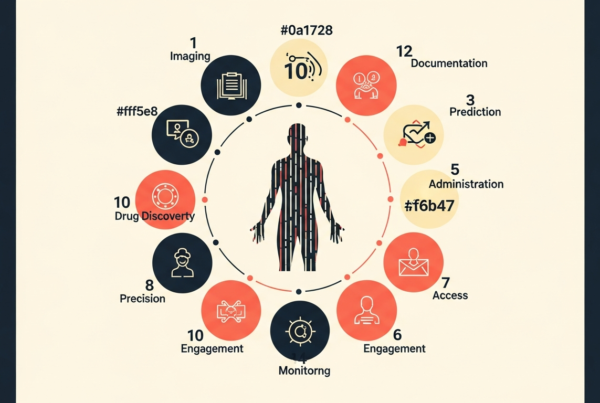
AI in healthcare falls into six practical categories: imaging and diagnostics, clinical documentation, risk prediction, patient communication, revenue cycle and administration, and drug discovery. In nearly all of them the AI assists a person, who reviews the output before it affects care.
Medical Imaging and Diagnostics
Imaging has the deepest published evidence. Besides the Swedish trial above, a real-world study of 463,094 women in Germany’s screening program, published in Nature Medicine in 2025, found that radiologists who used AI detected breast cancer at a 17.6% higher rate without a higher recall rate. An AI-enabled ECG algorithm studied at Mayo Clinic could identify people with atrial fibrillation from an ECG recorded during a normal heart rhythm. In 2018 the FDA granted a De Novo request for a system that automatically detects more than mild diabetic retinopathy in adults with diabetes, after a study at 10 primary care sites. These are results for narrow tasks; a model can perform differently on your own patients, so test locally before you trust it.
Clinical Documentation
Ambient documentation tools listen to a visit, with consent, and draft the note for the clinician to review and sign. The need is well documented: in an AMA-led study of 57 U.S. physicians, doctors spent nearly two additional hours on EHR and desk work for every hour of direct clinical face time. At The Permanente Medical Group, 7,260 physicians used AI scribes in more than 2.5 million patient encounters over a 63-week evaluation period. The AI drafts; the clinician remains responsible for the record.
Risk Prediction and Clinical Decision Support
Predictive models inside the EHR flag patients at risk of sepsis, deterioration, readmission or falls. They are also the category with the clearest cautionary tale. When Michigan Medicine researchers tested a widely used proprietary sepsis model on their own patients, it missed 67% of sepsis cases while generating alerts on 18% of all hospitalized patients. A helpful model and an exhausting one often differ less in the algorithm than in the threshold, the feedback loop and the people who own it.
Patient Communication
This is where most administrators and marketers meet AI first: scheduling and reminders, after-hours answers to routine questions, intake, follow-up messages and translation. It is also where patient information is most exposed, so scope matters. A well-built assistant answers general questions, hands clinical questions to people, and keeps patient details inside systems the practice controls. We cover this in depth in our guide to the future of chatbots in healthcare and in our walkthrough of HIPAA-aware AI implementation for healthcare.
Revenue Cycle and Administration
Prior authorizations, eligibility checks, coding, claim review and scheduling are high-volume, rules-based tasks, which makes them a common first step. The data is structured and a wrong output can usually be caught and reversed. For scale, a 2023 National Bureau of Economic Research working paper estimated that wider adoption of AI could save 5 to 10 percent of U.S. healthcare spending, roughly $200 billion to $360 billion a year in 2019 dollars. That is an economists’ estimate for the whole system, not a forecast for any one organization.
Drug Discovery
The longest-cycle category is also the one with a Nobel Prize. The 2024 chemistry prize recognized an AI model that solved what the Nobel committee called a 50-year-old problem: predicting a protein’s structure from its amino acid sequence. The open AlphaFold database covers almost every catalogued protein known to science, according to EMBL’s European Bioinformatics Institute. Progress to patients is slower. A 2025 phase 2a trial in Nature Medicine tested a drug whose target and molecule were both found with generative AI, and its authors note that few AI-discovered drugs have reached human trials.
The Rise of AI Agents, and Why Executives Need to Pay Attention
An AI agent does more than answer a question: it carries out a multi-step task toward a goal, across several systems, with people reviewing the exceptions. That changes how work is divided between staff and software, which is why it belongs on the executive agenda. A 2026 scoping review in npj Digital Medicine maps the published work on agentic AI in healthcare so far.
In Deloitte’s 2026 US Health Care Outlook Survey, over 80% of health care executives said they expect both agentic and generative AI to deliver moderate-to-significant value across clinical, business and back-office functions in 2026. The same Deloitte report points to early deployments: Humana’s agentic tool that helps its member advocates answer questions, Stanford Health Care’s pilot that brings personalized real-world evidence into the EHR at the point of care, and Mayo Clinic’s work on AI agents for provider and payer administrative workflows.
In practical terms, an intake agent could collect pre-visit forms, sync them to the EHR, check insurance and flag possible care gaps before the patient arrives, with staff reviewing anything outside the routine. Because an agent acts, it needs clearer limits than a tool that only suggests: what it may do alone, what needs approval, and who can switch it off.
The Benefits of AI in Healthcare, and the Trade-Offs
The benefits are real, and each one comes with a trade-off that someone has to manage. Hold both at once when you weigh a proposal.
- Earlier detection in imaging. Trade-off: models perform well on the populations they were built on and can slip on patients who look different. Local validation is the work.
- Less documentation time. Trade-off: a draft that “sounds right” can carry small errors past a tired reviewer. Spot audits matter.
- Earlier warning of deterioration. Trade-off: a model tuned badly produces alert fatigue, as the sepsis study above showed.
- Lower administrative load. Trade-off: AI added to a broken process automates the dysfunction instead of removing it.
- Wider access through triage and translation. Trade-off: translation quality varies by language, and triage rules can inherit bias from their data.
- Decision support at the point of care. Trade-off: over-reliance. If clinicians stop questioning the suggestion, the safety net gets thinner.
Other costs to plan for: performance that drifts quietly as patients and practice change, more vendors handling sensitive data, switching costs once a tool is central to a workflow, and real change for administrative roles. None of these is a reason to avoid AI. All of them are reasons to deploy it deliberately.
The Elephant in the Boardroom: Executive Hesitation and the AI Stigma
Most healthcare executives are interested in AI but do not have a plan for it. A 2025 Sage Growth Partners survey of 101 hospital and health system executives found that only 13% had a clear strategy for integrating AI into clinical workflows.
The barriers are documented. In the same survey, nearly 70% agreed that data privacy and security concerns are a major barrier to AI adoption. A global cross-sectional survey of 506 health care professionals, published in the Journal of Medical Internet Research, found that poor knowledge of AI, fear of job loss and resistance to change were the main barriers to adoption.
The deeper issue is often unspoken: many leaders feel a stigma around admitting they do not fully understand AI. They have used ChatGPT to draft an email, and they equate that with what AI can do. The distance between consumer-grade AI and an enterprise healthcare deployment is wide, and closing it takes deliberate education. Harvard T.H. Chan School of Public Health now offers an AI in Health Care Certificate of Specialization, one sign that the knowledge gap is common enough to warrant formal programs.
The Major Platforms: What Healthcare Leaders Need to Know
For work that involves patient information, the question is not which chatbot is smartest but which product the vendor will cover under a signed business associate agreement (BAA), and how it must be configured. Understanding this at a strategic level, not a technical one, is enough to ask vendors the right questions. The facts below come from each vendor’s own pages, read in November 2026. Terms change, so confirm them before you sign.
Anthropic (Claude)
Anthropic introduced Claude for Healthcare in January 2026, a set of tools that lets providers, payers and health tech companies use Claude through what Anthropic calls HIPAA-ready products. Anthropic provides a BAA covering its first-party API and Enterprise plans that have been set up for it, with some features excluded, so configuration matters as much as the contract.
Microsoft (Azure and Copilot Health)
Microsoft launched Copilot Health in March 2026 as a consumer product: a separate space in Copilot where individuals bring together their own health information. Microsoft says Copilot Health conversations are isolated from general Copilot, encrypted and not used for model training, and that the service has achieved ISO/IEC 42001 certification for AI management systems. For organizations, Microsoft offers a BAA that covers its in-scope cloud services.
Google (Gemini and Google Cloud)
Google Cloud’s BAA covers its infrastructure and a published list of products, including the Cloud Healthcare API, and Google tells customers not to use unsupported services with patient information.
OpenAI and Everyone Else
Apply the same test to OpenAI and to any other vendor: ask for the current written BAA terms, the exact list of covered products and plans, and the settings that coverage depends on. Do not rely on a summary, including this one.
A Critical Point for All Platforms
A free or personal chatbot account is not the same product as the one a vendor covers under a BAA. If your team is pasting patient information into a consumer chat window, you have a problem no matter how helpful the output is. We answer the most common version of this question in whether ChatGPT can be used with patient information.
Choosing AI Tools by Category
There is no single right AI tool for healthcare; there is a right tool for a specific job. Start from the job, shortlist by category, and test on your own data before you buy. We do not rank vendors here, because rankings age within months and the right choice depends on your EHR, size and specialty.
- Clinical imaging and diagnostics. Start from the FDA’s public device list and ask for the published study behind the product.
- Ambient documentation. Ask how notes are reviewed and signed, how the tool fits your EHR, and what happens to the audio.
- Risk prediction. Ask for performance on a population like yours, and for the alert rate, not only the accuracy.
- Patient communication. Ask what the assistant will refuse to answer, when it hands off to a person, and where conversations are stored.
- Revenue cycle and administration. Ask which steps are fully automated and which are queued for staff, and how errors are caught.
- General-purpose assistants. Use only business or enterprise products covered by a signed BAA for anything involving patient information.
Across every category, the questions that separate substance from sales copy are the same: Will the vendor sign a BAA as standard? Is your data used to train its models? Are there audit logs? Can you speak with reference customers of your size and specialty? Will the vendor share performance across demographic groups? Will it support a 30-to-90-day pilot with success measures agreed in writing first? Pressure to skip the pilot, vague answers about training data, and demo results far better than any published benchmark are reasons to slow down.
Guardrails and Governance: The Non-Negotiable Foundation
Governance is what decides whether AI helps or harms, and most organizations have more policy than practice. A December 2025 survey of 51 healthcare organizations by Censinet and the CHIME Foundation found a governance gap: high-level structures are in place, but the operational processes and controls needed to manage AI safely lag behind.
Executives should own these layers, not leave them entirely to IT:
- An inventory. Every AI tool in use, its purpose, its owner and how it is performing. Include the tools staff adopted on their own.
- Agreements before data. No patient information goes to a vendor without a signed BAA and a clear list of what it covers. Your privacy officer and your own advisers make that call.
- Where data lives. Ask each vendor where prompts and outputs are processed and stored, whether they are encrypted, and set region and retention options yourself instead of assuming a default.
- A human in the loop. The AI produces the first draft of a note, a suggestion or a message. A qualified person validates, interprets and decides.
- Local validation and monitoring. Test the tool on your own population before go-live and keep measuring afterward. Performance on day one is not performance a year later.
- A named owner and an off switch. Someone with the authority to pause the tool, and a record of when and why.
- Bias checks. Review outputs across patient groups on a schedule, especially for triage and decision support.
- Audit trails and transparency. Log what the AI did and be able to show why. Being able to explain how a conclusion was reached is the same principle behind EEAT standards for digital trust.
Public bodies are moving the same way. ONC describes its HTI-1 final rule as establishing transparency requirements for AI and other predictive algorithms that are part of certified health IT. The FDA, Health Canada and the U.K.’s medicines regulator released guiding principles for good machine learning practice in October 2021. The NIH’s Bridge2AI program exists to produce AI-ready data that is accurate, reliable and ethically sourced, a reminder that a model is only as good as its data. For the step-by-step version in a clinic setting, see HIPAA-aware AI implementation for healthcare.
Deploying AI in a Way That Empowers Your Team
AI adoption works when it starts with the problems your clinicians and staff want solved, and fails when it is imposed on them. Begin with the workflows people dislike most.
Documentation is the usual one. In the AMA-led study cited above, physicians who kept diaries reported one to two hours of after-hours EHR and clerical work each night. A tool that gives part of that evening back is welcomed, not feared. The same is true of prior authorization work for a billing team.
The deployments that last tend to share a pattern:
- A written problem statement first, a vendor demo second.
- A named clinical or operational owner with the authority to pause the tool.
- Testing on your own patients or data before go-live, and monitoring after.
- The AI placed where people already work, not in another system to log into.
- Plain communication: staff know what the tool can and cannot do, and patients know when AI is used.
Add baseline AI literacy for every role, covering privacy, monitoring and when to escalate to a person. This is not about turning nurses into data scientists. Then tie each deployment to an objective you already have. If the plan is shorter wait times, start with scheduling. If it is margin, start with revenue cycle. AI is not a strategy; it speeds up the one you have.
What the Future Looks Like, and What to Do Now
Expect more capable agents, tools that combine text, images and audio, and tighter oversight, with people still accountable for decisions. As Stanford School of Medicine dean Lloyd Minor put it in the title of his Harvard Business Review article, AI alone won’t transform U.S. healthcare. The change comes from AI combined with workflow redesign, culture and governance.
For the healthcare executive reading this today, a workable plan:
First, audit your current AI exposure. Your teams are almost certainly using AI tools already, possibly without approval. Find out what is happening before trying to control it.
Second, invest in your own education. Leadership knowledge is a real bottleneck to responsible adoption.
Third, set governance before you scale. Agreements, human review, monitoring, ownership and audit trails are far easier to build first than to retrofit after an incident.
Fourth, start with lower-risk, high-friction work. Administrative tasks, documentation support and scheduling let the organization build confidence before it moves to clinical decision support. Measure your own baseline before and after, because published results vary.
Fifth, choose platforms and tools by fit. Judge them on your existing systems, your EHR and the agreements each vendor will sign, not on which chatbot your team likes.
To keep up without drowning in headlines, read primary sources: the FDA device list, the study behind any product you are considering, and your vendors’ own terms pages. Vendor summaries and news digests age quickly.
Frequently Asked Questions
How is AI used in healthcare today?
In six main ways: reading medical images, drafting clinical notes, predicting patient risk, handling routine patient communication, automating revenue cycle and administrative work, and speeding up drug discovery. Most deployments are assistive, meaning a person reviews the AI’s output before it affects care.
Is AI replacing doctors?
No. The tools described in this guide draft, flag and prioritize; clinicians review, sign and decide. AI is changing how much time goes to documentation, image review and paperwork. Some administrative roles are changing more, and workforce planning should account for that.
What are the biggest risks of AI in healthcare?
Bias against groups that were underrepresented in the data, performance that degrades quietly when a model meets a different population, over-reliance by busy staff, and privacy exposure when patient information reaches a vendor without the right agreement. Each needs ongoing monitoring, not a one-time check.
Can staff put patient information into ChatGPT or another consumer chatbot?
Not into a free or personal account. Patient information belongs only in products the vendor covers under a signed BAA, configured the way that agreement requires. See our answer on ChatGPT and patient information for the detail, and ask your privacy officer about your own situation.
How much money could AI save in healthcare?
Estimates vary widely. A 2023 National Bureau of Economic Research working paper estimated savings of 5 to 10 percent of U.S. healthcare spending from wider AI adoption. For one organization, the only reliable number is your own before-and-after measurement.
What is the difference between AI, machine learning and generative AI?
Machine learning is the part of AI that learns patterns from data, and most healthcare “AI” is machine learning. Generative AI is a newer branch that produces text, images or code. The differences matter for how a tool is tested, less for how patients experience it.
Where should a healthcare organization start with AI?
With one specific, high-friction workflow and a written definition of success. Run a time-limited pilot, build your governance around that first deployment, then extend it. A useful first question is which process, if it had far less friction, would most change patient access or staff capacity this year.
From the 210 Digital Marketing Podcast Library
210 Digital Marketing produces podcasts for healthcare and behavioral-health audiences. For a plain-English take on what AI does and what it costs, listen to AI For Luddites, or see how we approach podcast production for healthcare organizations.
The Bottom Line
AI in healthcare is a leadership matter before it is a technology one. The executives who take the time to understand the landscape, set governance first and deploy AI in service of goals their teams already share are the ones positioned to use it well.
210 Digital Marketing is a healthcare-only agency: we take on healthcare organizations only, and have since 2005. Our focus is patient acquisition, and our AI work is HIPAA-aware: 210 is designed so patient information never reaches us. We help leadership teams put AI to work on the patient-facing side of the organization through our AI implementation work, alongside the rest of our healthcare marketing services. To talk through where AI fits your objectives, schedule a 45-minute conversation.
Related: As AI changes the industry, healthcare marketing careers are changing too.
Related Reading
- AI capabilities: how 210 implements AI for healthcare organizations
- HIPAA-aware AI implementation for healthcare
- The future of chatbots in healthcare
- ChatGPT and patient information: what healthcare teams need to know
- How Do I Use AI for Marketing? A Practical Guide for Healthcare Teams
- AI and Search: Should I Be Concerned About SearchGPT and AI Overviews?
- About 210 Digital Marketing
How we research and fact-check: every statistic links to its source. Read our editorial standards.