The “One Generic MHAM Post” Problem
Every May, behavioral health marketers fall into the same trap. A green ribbon goes up on the homepage, somebody writes a short “Mental Health Awareness Month is here” post that defines anxiety and lists three coping skills, and then the calendar rolls over to June. The content sits on the blog like a tombstone — no internal links pointing to it, no follow-on coverage, no search authority compounded into the rest of the funnel.
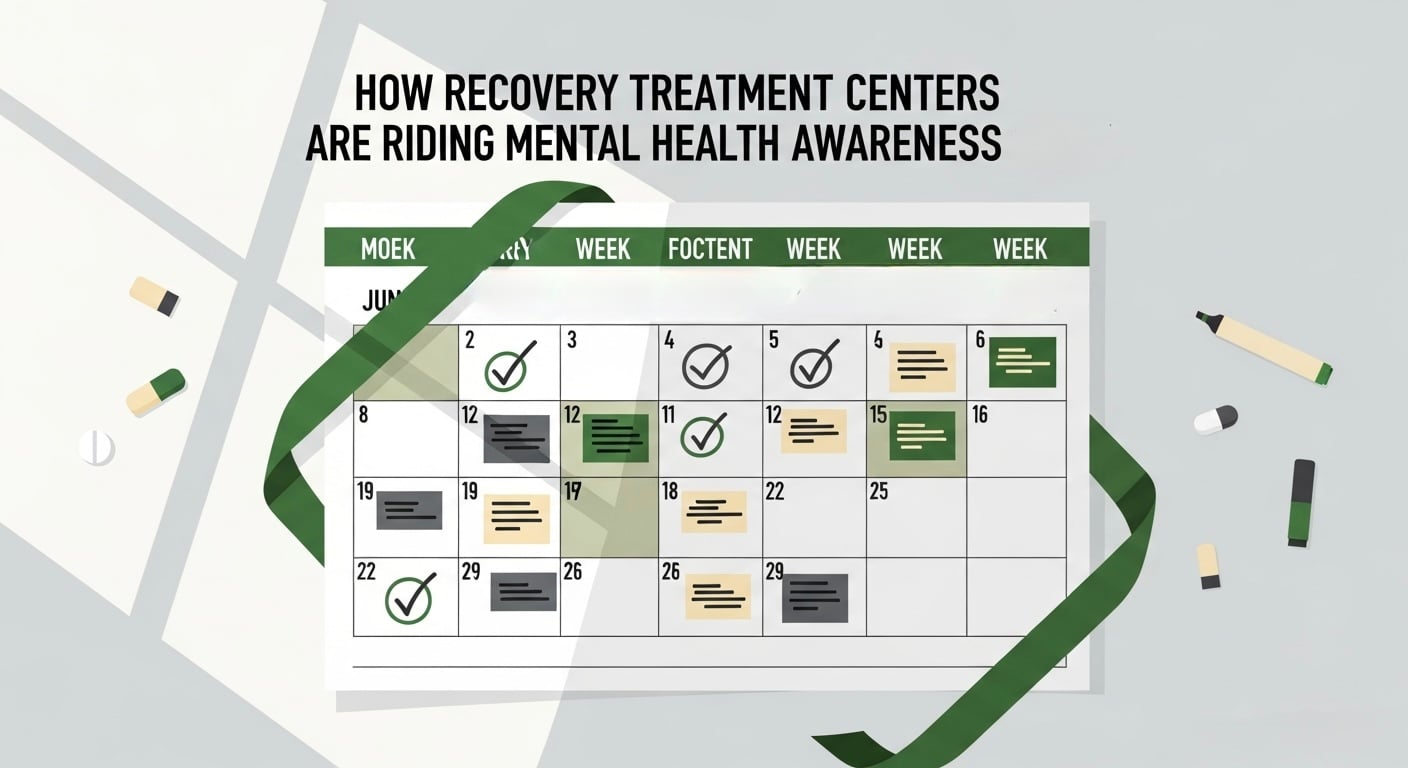
Four weeks, four themes. SAMHSA’s 2026 MHAM framing turned into a four-post content sprint for behavioral health practices.
That is a missed opportunity, and in 2026 it is a bigger one than usual. SAMHSA has segmented this year’s Mental Health Awareness Month toolkit into four discrete weekly themes, each with its own key messages, sample social posts, and hashtags such as #MHAM2026 and #SeeThePerson. That is not a vibe — it is a content brief, handed to behavioral health operators for free, with a built-in topic structure you can mirror on your own site.
This is the playbook we run at 210 Digital Marketing for behavioral health and treatment-center clients. If you operate a behavioral health practice and you are still publishing one MHAM post a year, the rest of this post explains what a four-week sprint looks like, how to wire it into your existing program pages, and how to bridge the momentum into June PTSD Awareness Month before it cools off.
SAMHSA’s 4-Week Framing for May 2026
SAMHSA’s 2026 toolkit organizes May into four themed weeks. The themes move from understanding, to early signs in young people, to language, to supporting loved ones, which maps loosely onto the path a family takes toward care. The weeks, as SAMHSA published them:
- Week 1 (May 1–8): Understanding Mental Illness, Including Serious Mental Illness — awareness leads to compassion
- Week 2 (May 11–15): Early Support Matters — recognizing signs in children and youth
- Week 3 (May 18–22): Words Matter and Words Can Heal — language that recognizes the whole person and opens the door to care
- Week 4 (May 25–29): Supporting Loved Ones — connection as a powerful form of care
If you squint, that is a content outline. Four pillar topics, each framed by a federal agency that journalists, schools, and HR teams will reference all month long. Check Google Trends for your own head terms and long-tails to see how interest moves through May in your market.
The Four-Post Sprint: One Post Per Week
Instead of one generic post, publish four substantial posts, one per week, each anchored to that week’s SAMHSA theme. Publish at the start of each themed week so your social distribution rides the SAMHSA-driven news cycle. SAMHSA’s themes are general mental health; the angles below show how a treatment center can connect each one to the care it provides.
Week 1 — Understanding Mental Illness
Suggested angle: “Co-Occurring Disorders, Explained: Why [Condition A] and [Substance Use] Travel Together.” Pick the specific dual-diagnosis pairing your facility treats best. This is the awareness-stage piece — the reader is curious, not yet shopping.
Keyphrase pattern: “[condition] and [substance] co-occurring disorder” plus related “what is dual diagnosis” long-tails.
SEO move: Build the post as a definitional pillar with an FAQ block. Definitional, question-and-answer content matches how people search, and Pew found that question-style searches are more likely to trigger a Google AI summary. Mark up the FAQ with FAQPage schema so it is described accurately. Link down to your conditions-treated pages.
Week 2 — Early Support Matters
Suggested angle: “The Conversation Before the Conversation: How Parents Can Recognize [Condition] in a Teen Before a Crisis.” SAMHSA’s Week 2 theme is children and youth, so write for the parent searching late at night — high commercial intent disguised as informational intent. If you don’t treat adolescents, write for the adult family member instead and say who you serve.
Keyphrase pattern: “signs of [condition] in a teenager,” “signs of [condition] in a [family member type],” “how to talk to a [loved one] about [condition].”
SEO move: This is likely the highest-intent post of the sprint. Lead the reader to a screening tool or a “talk to admissions” CTA above the fold of the body content, not just in the sidebar. Internal link to your family resources page and your admissions process page. Skip HowTo schema: Google stopped showing How-to rich results in 2023.
Week 3 — Words Matter (and the Path to Care)
Suggested angle: SAMHSA’s Week 3 theme is language — words that recognize the whole person and make it easier to reach out. Use it twice. First, audit your own program pages for stigmatizing terms. Then publish the post families need once they are ready to act: “What Insurance Actually Covers for [Level of Care]: A 2026 Breakdown.” Yes, write the post nobody wants to write. Cost is one of the first practical questions families ask, and clinical teams rarely want to write about money.
Keyphrase pattern: “does [insurer] cover [level of care],” “cost of [program type] without insurance.”
SEO move: This is your money-keyword post. Tables, not paragraphs. Include the major payers you accept, a Verify Benefits CTA, and Service schema. Internal link from this post to every program page on the site. Pages that rank for cost queries can keep bringing qualified traffic year-round, long after MHAM ends.
Week 4 — Supporting Loved Ones
Suggested angle: “How Families Can Support Someone in Long-Term Recovery.” SAMHSA’s Week 4 theme is connection as a form of care, which fits a brand-building post on what recovery looks like after discharge: family roles, alumni, and the unglamorous reality of step-down care. Alumni quotes need the person’s written authorization, and outcome claims need solid evidence.
Keyphrase pattern: “long-term recovery support,” “[your city] alumni program,” “what happens after rehab.”
SEO move: This is your EEAT post. Get a clinical reviewer’s byline on it, include only outcome metrics you can document (de-identified and aggregated), and cite peer-reviewed research. Link to your alumni page, your aftercare program, and your sober-living partners. On health topics, Google says its systems give even more weight to strong E-E-A-T; credentialed authorship and review are how you show it (more in our guide to what E-E-A-T means in AI search).
Internal Linking: How the Sprint Becomes a Topic Cluster
The four posts only compound if you wire them together. Treat the Week 1 definitional post as a hub. Weeks 2, 3, and 4 each link back to it with descriptive anchor text matching the cluster (“understanding co-occurring disorders,” not “click here”). The hub returns links to each spoke.
Then anchor every spoke into existing money pages:
- Week 1 → conditions-treated and therapies pages
- Week 2 → admissions, family resources, screening tool
- Week 3 → every level-of-care page, insurance/verify-benefits page
- Week 4 → family program, alumni, aftercare, outcomes page
This is the move many behavioral health sites miss. The MHAM posts become part of the site’s topical depth, not a seasonal vanity project. Our case studies show how we report results for behavioral health operators.
Bridging Into June PTSD Awareness Month
Here is the part that is easy to forget: in 2026, May ended on a Sunday, and PTSD Awareness Month started Monday morning. Your Week 4 “Supporting Loved Ones” post should already foreshadow the June pivot — a section on “Recovery When Trauma Is the Underlying Driver,” with a tease and an internal anchor pointing to a June 1 PTSD pillar post that does not exist yet.
Then build June around the same four-stage architecture: understanding PTSD → recognizing it → connecting to trauma-informed care → long-term post-traumatic growth. The overlap between the May and June clusters compounds: two months of connected, well-linked posts on adjacent topics build the depth that competitive head terms like “trauma treatment [your metro]” reward.
The VA’s National Center for PTSD publishes PTSD Awareness Month resources you can cite, link out to, and reference for credibility.
Yoast Premium Settings That Move the Needle
Mechanics matter. For every post in the sprint, configure Yoast Premium with intent:
- Focus keyphrase: Single, specific, matching search intent. Not “mental health” — “co-occurring anxiety and alcohol use disorder.”
- Related keyphrases (Premium): Add the close variants people actually search. Yoast scores your content against each one, which keeps the post covering the topic rather than repeating one phrase. (Google says its AI systems understand synonyms, so this is about coverage for readers, not a trick for AI; more on that in our practical guide to using AI in healthcare marketing.)
- Internal linking suggestions: Use the Premium suggestions panel, but override aggressively. The tool is a starting point, not the answer.
- Schema: Article + FAQPage on Week 1 (Google limits FAQ rich results to well-known government and health sites, but the markup still describes the page), Article on Week 2, Article + Service on Week 3, and on Week 4 a Person node for the clinical reviewer linked from the page’s reviewedBy property.
- Social previews: Custom OG image and copy per post. The four social cards should look like a series, not four random posts. Visual continuity earns shares.
- Cornerstone content: Mark the Week 1 hub as cornerstone so Yoast Premium’s internal-linking suggestions favor it across the site.
For deeper config, the Yoast documentation on Premium’s related-keyphrase and internal-link tools is the canonical reference. For the practice-side picture, see our healthcare SEO approach.
Want 210DM to Run This for Your Practice?
The four-post May sprint plus the June continuity is a real block of strategy, writing, clinical review coordination, on-page SEO, schema, and internal-link rewiring. Many treatment-center marketing teams do not have that capacity in May — they are running events, awareness campaigns, and family programming on top of the day job.
That is what we do at 210 Digital Marketing. We have worked only in healthcare since 2005, and behavioral health and recovery is a core focus; the MHAM-into-PTSD sprint is one of the most useful plays on the annual calendar. If you want us to scope this for your facility, get in touch — we will audit your existing topical authority, identify which programs are underserved by your current content, and come back with a sprint plan for May 2027 (and the bridge into June). SAMHSA sets new themes each year, so we check its toolkit before we plan.
One generic MHAM post is a missed month. Four well-wired posts keep earning traffic in November, when nobody else is talking about it.
Related Reading
How we research and fact-check: every statistic links to its source. Read our editorial standards.