Healthcare video has two jobs, and most practices only ask it to do one. The first job is marketing: patient stories, procedure explainers, and health-tech demos that build trust and bring new patients in the door. The second job is training: teaching your staff and your patients through real stories, screen recordings, and short modules that you can actually measure. Many agencies that offer healthcare video marketing stop at job one. Job two, the training side, is where video quietly delivers some of its highest return, because comprehension is measurable, repeatable, and tied directly to outcomes you care about, such as cleaner intakes, faster software adoption, and fewer compliance gaps. This guide treats both jobs as one strategy. We will cover what good marketing video looks like in a regulated environment, why measurable training video, the kind built with pre- and post-testing, is an under-served and high-value category, and how to plan, produce, and distribute both without overcomplicating your operation. The goal is simple: make every video you produce earn its keep, whether it acquires a patient or trains the person who will care for them.
Key takeaways
- Healthcare video does two jobs: marketing that acquires patients and training that educates staff and patients. Plan for both, not just the first.
- Marketing video earns trust through patient stories, plain-language explainers, and honest health-tech demos, not slick claims.
- Training video becomes high-value when you measure it with pre- and post-testing so you can prove comprehension, not just completion.
- Most agencies only produce marketing video; measurable training video is an under-served category with direct operational payoff.
- Compliance is not an afterthought. HIPAA-aware production and 42 CFR Part 2 fluency protect both jobs from costly mistakes.
The Two Jobs Healthcare Video Should Be Doing
When people say healthcare video marketing, they usually picture one thing: a polished brand film or a patient testimonial meant to bring in new business. That is real and it matters, but it is only half of what video can do for a healthcare organization. Video has a second, quieter job that often produces more durable value, and that is teaching. The same medium that can move a prospective patient to book a consultation can also onboard a new clinician, walk a patient through post-procedure care, or get your whole front desk fluent in a new scheduling system. One discipline, two jobs.
Job one is marketing. This is video aimed outward at people who are not yet patients: explainers that answer the questions they are typing into search, patient stories that show real outcomes, and demos that make an unfamiliar technology feel safe and understandable. Done well, it shortens the distance between a stranger’s first search and their first appointment.
Job two is training. This is video aimed inward at the people who keep your organization running, and outward at existing patients who need to understand what happens next. Clinical onboarding, compliance refreshers, EHR and software adoption, and patient education all live here. What separates real training video from a recorded lecture nobody finishes is measurement, and that is the part most providers have never been offered.
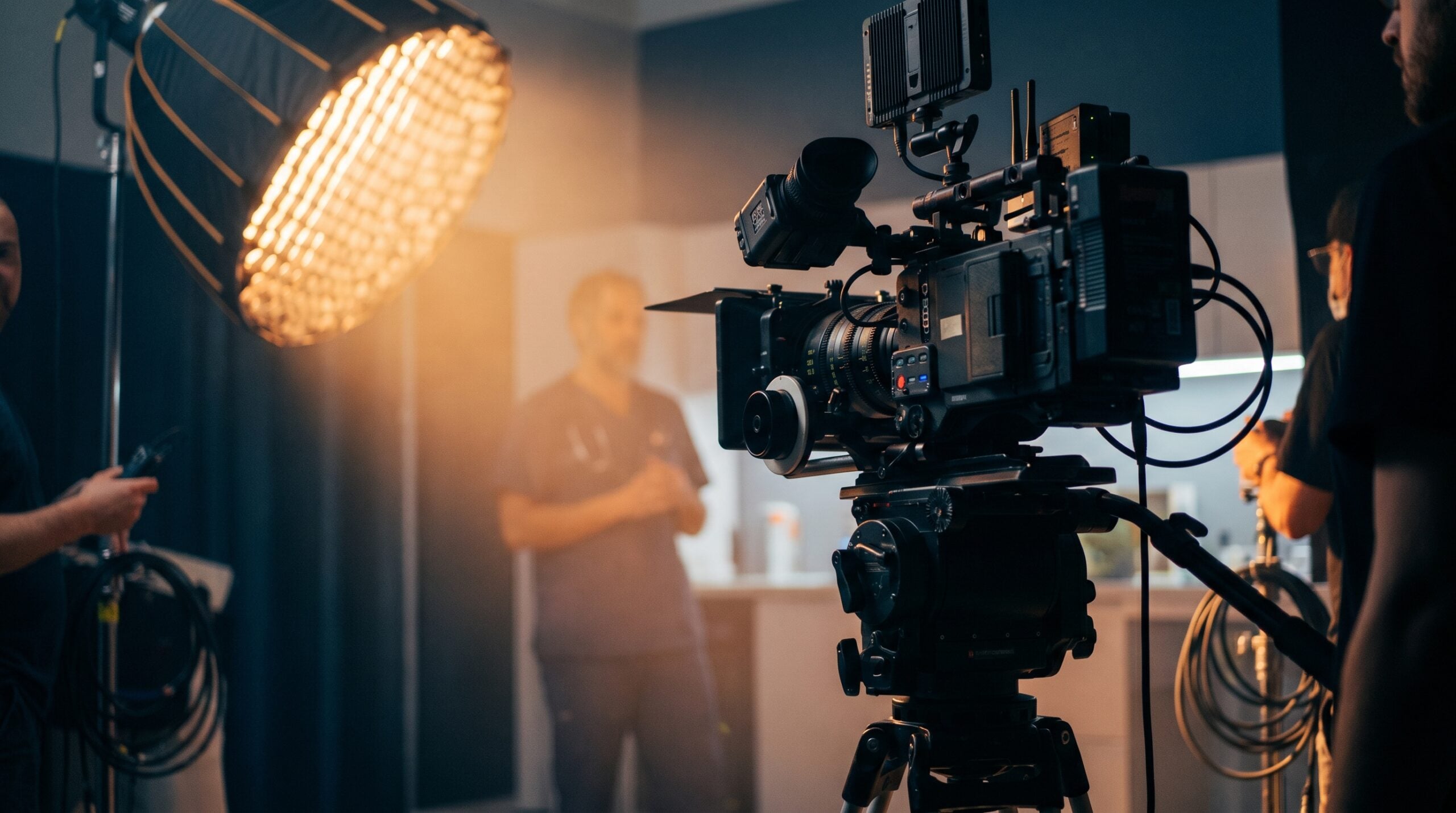
Treating these as two halves of one strategy changes how you budget, script, and reuse footage. A single afternoon of filming a clinician can yield both a trust-building marketing clip and a procedure-prep module for patients. The organizations that get the most from video are the ones that stop thinking of marketing and training as separate line items and start thinking of video as a single capability with two outputs.
Marketing Video That Actually Builds Trust and Acquires Patients
In healthcare, trust is the conversion. Nobody chooses a surgeon, a behavioral-health program, or a specialty clinic on price alone; they choose the one they believe will take care of them. That is why the strongest medical video marketing is not the most expensive or the most cinematic. It is the most honest. A clinician explaining, in plain language, what a procedure involves and what recovery actually feels like will outperform a glossy montage of stock smiles every time, because it answers the questions a worried person is genuinely asking.
Three formats carry most of the weight. Patient stories, told with consent and care, let prospective patients see themselves in someone who was once in their shoes. Explainers translate a condition, a treatment, or an insurance question into something a non-clinician can follow, and they happen to map directly onto the searches people run before they ever call. Health-tech demos show how a portal, a remote-monitoring device, or a telehealth visit really works, which removes the friction of the unknown. Each of these formats does the same underlying thing: it reduces uncertainty.
Two findings are worth knowing. In Wyzowl’s 2026 survey, 85% of people said they have been convinced to buy a product or service by watching a video. And in a 2020 experiment published in the Journal of Medical Internet Research, 43% of participants who saw only negative reviews of a primary care provider said they would still make an appointment, with many crediting the provider’s short video introduction. What matters operationally is that marketing video only works when it is distributed deliberately. A film that lives on a hidden page does nothing. Paired with search, paid media, and social, the same clip can answer a question on your website, qualify a lead in an ad, and reassure a follower on a feed. Production and distribution are one project, not two.
The Under-Served Half: Measurable Training Video
Here is the gap. Search for healthcare video marketing and you will find no shortage of agencies ready to make you a brand film. Search for a partner who will build a healthcare training video program and measure whether anyone actually learned anything, and the field thins out fast. Most agencies stop at job one because marketing video is what clients ask for and what is easy to sell. Training video gets treated as an internal chore, filmed on a phone, posted to a shared drive, and never looked at again.
That is a missed opportunity, because training is where video’s value is most measurable. A marketing video’s impact is real but diffuse; a training video’s impact can be tested directly. The mechanism is straightforward: you assess what learners know before the video, you deliver the module, and you assess again afterward. The difference between those two scores is comprehension you can actually point to. Pre- and post-testing turns training video from a box you check into a result you can prove, and it tells you exactly which modules are working and which need a rewrite.
This is the part of video that 210 treats as a first-class discipline rather than an afterthought. Real stories make the lessons stick, screen recordings show software exactly as staff will see it, and pre/post testing measures whether the message landed. When comprehension dips on a particular module, you fix that module instead of guessing. Over time you build a library of training content with a track record, not just a runtime. That combination, narrative plus measurement, is rare, and it is precisely why measurable training video is such an under-served, high-value category.
Training Video in Practice: Onboarding, Compliance, Software, and Patient Education
Clinical onboarding is the most obvious place to start. New hires in a healthcare setting face a flood of policies, workflows, and unwritten norms in their first weeks. Video lets the best version of that training happen every time, consistently, without pulling a senior clinician off the floor to repeat the same orientation. A new team member can watch, rewatch, and be tested, and you get a record that they understood the material rather than merely sat through it.
Compliance training is the second pillar, and it is where measurement stops being a nice-to-have. HIPAA expectations and, for substance-use and behavioral-health programs, the heightened confidentiality rules of 42 CFR Part 2 are not topics you want to leave to a forwarded PDF. Video that walks staff through realistic scenarios, paired with post-testing that documents comprehension, gives you both better-trained people and a defensible record that the training happened and was understood. Because 210 works only in healthcare, that compliance fluency is built into how the content is made, not bolted on after.
EHR and software adoption is the third, and it is often the most immediately profitable. New clinical or practice-management software fails not because the tool is bad but because people never fully learn it. Screen-recorded walkthroughs that show the actual interface, step by step, can shorten the adoption curve and reduce the support tickets that follow a rollout. Test comprehension afterward and you know who is ready and who needs another pass before go-live.
Patient education is the fourth, and it bridges both jobs. A patient education video that explains pre-visit preparation, medication instructions, or post-procedure care can reduce confusion, errors, and anxious phone calls, while also reinforcing the trust your marketing worked to build. The same care you put into teaching staff applies here: plain language, real scenarios, and, where it fits, a quick check that the patient understood what to do next.
Where AI Fits, and Where It Should Not
Video is one of the places where artificial intelligence is genuinely useful right now, as long as it stays in its lane. The practical wins are in production and reach: AI-assisted transcription makes every video searchable and accessible, multilingual cutdowns let a single shoot serve English- and Spanish-speaking audiences without re-filming, and automated tagging helps your content surface in both traditional search and the AI-generated answers patients increasingly rely on. These are leverage points that make a modest production budget go further.
AI also strengthens the training half specifically. When you are running pre- and post-testing across a library of modules, AI can help analyze comprehension patterns, flag which segments lose learners, and surface the questions people get wrong most often, so your next revision is informed rather than guessed. Our AI capabilities page goes deeper on how this kind of measurement and adaptation works in a healthcare context.
What AI should not do is replace clinical judgment, fabricate patient stories, or make claims your organization cannot stand behind. In a regulated field, the credibility of every video rests on it being true and compliant. The right posture is to let AI handle the repetitive production and analysis work, freeing experienced people to focus on accuracy, empathy, and the parts of the message that only a human who understands healthcare can get right.
How to Plan a Video Program That Does Both Jobs
Start by listing your goals on both sides of the ledger. On the marketing side, name the questions prospective patients ask before they book and the technologies or services they find confusing. On the training side, name the moments where comprehension actually matters: onboarding, a software rollout, a compliance requirement, a patient-care instruction people frequently get wrong. The overlap between these two lists is where your first videos should live, because that footage and that clinician’s time can serve both jobs at once.
Plan for measurement from the beginning, not as something you tack on later. For marketing, that means tying videos to distribution and tracking what they actually drive, which is where analytics and attribution earn their keep. For training, it means designing the pre- and post-tests alongside the script so the assessment and the content reinforce each other. A module written with its test in mind is almost always clearer than one written in isolation.
Finally, decide who is going to do this work, because healthcare video is not a place for guesswork or junior hand-offs. The regulatory stakes, the clinical accuracy, and the need to measure comprehension all reward experience. 210 has worked only in healthcare since 2005, delivers with senior people rather than handing your project to a trainee, and treats marketing and training as one capability rather than two unrelated services. If you are weighing whether to build this internally or bring in a partner, the deciding question is simple: can whoever does it both tell a trustworthy story and prove that someone learned from it?
Related Reading
- 210 Digital Marketing | Healthcare Digital Marketing Agency
- The Healthcare Executive’s No-Nonsense Guide to AI in 2026
- How Do I Use AI for Marketing? A Practical Guide for Healthcare Teams
- Healthcare’s Zero-Click Reality: Winning AI Overviews in 2026
- The 7 Objectives of Healthcare Marketing in 2026
Frequently asked questions
What is the difference between healthcare video marketing and healthcare training video?
Marketing video is aimed outward at people who are not yet patients. Its job is to build trust and acquire patients through stories, explainers, and demos. Training video is aimed at your staff and existing patients. Its job is to teach, and its value comes from being measurable through pre- and post-testing. Both use the same medium, but they serve different goals, and a smart program plans for both rather than just the marketing half.
Why do most agencies only offer marketing video and not training video?
Marketing video is what most clients ask for and what is easiest to sell, so it is where agencies concentrate. Training video is often treated as an internal chore and filmed informally, which means the measurable, high-value version, built with real stories, screen recordings, and pre/post comprehension testing, rarely gets offered at all. That gap is exactly why measurable training video is such an under-served category and where a healthcare-specialized partner adds real value.
How do you measure whether a training video actually worked?
The most reliable method is pre- and post-testing. You assess what learners know before they watch a module, deliver the content, then assess again afterward. The improvement between the two scores is comprehension you can document, not just a completion checkbox. This also shows which specific modules are effective and which need revision, so you can improve the content over time instead of guessing.
Is healthcare video subject to HIPAA and other privacy rules?
Yes. Any video involving real patients, real records, or protected health information must be produced with HIPAA awareness, including proper consent and careful handling of footage. Behavioral-health and substance-use programs face the additional, stricter confidentiality requirements of 42 CFR Part 2. Compliance should be built into how the video is made from the start, which is why working with a partner fluent in these rules matters.
Can one video shoot serve both marketing and training purposes?
Often, yes. A single session with a clinician can yield a trust-building marketing clip and a patient-education or staff-training module from the same footage and preparation. Planning both outputs before you film is what makes this efficient, and it is one of the biggest reasons to treat marketing and training as a single video capability rather than two separate projects.
How does AI help with healthcare video without compromising accuracy?
AI is most useful in production and analysis: transcription that makes videos searchable and accessible, multilingual cutdowns that serve English and Spanish audiences from one shoot, tagging that helps content surface in search, and analysis of comprehension patterns across training modules. What AI should not do is replace clinical judgment or generate claims your organization cannot stand behind. The right balance lets AI handle repetitive work while experienced people guard accuracy and compliance.
The bottom line
Healthcare video is most powerful when it does both of its jobs. The marketing half earns trust and brings patients in; the training half teaches the people who care for them and proves, through measurement, that the teaching worked. Most providers have only ever been offered the first half. The second, measurable training video built on real stories, screen recordings, and pre- and post-testing, is where a surprising amount of value is sitting untapped, and it is exactly the kind of work that rewards a partner who lives in healthcare every day rather than dabbling in it.
If you are ready to make every video you produce earn its keep, whether it acquires a patient or trains the person at the front desk, we would be glad to talk it through. Schedule a conversation and let’s map out a video program that does both jobs well.
Related from 210
- Healthcare video SEO for AI search →
- Healthcare video training programs →
- Healthcare video production services →
- Our AI capabilities for healthcare →
- Analytics and attribution →
- Schedule a conversation →
- Healthcare Marketing Agency →
- SEO →
- TV vs. Digital vs. B2C: Choosing the Right Healthcare Advertising Channel Mix →
How we research and fact-check: every statistic links to its source. Read our editorial standards.