Ask most healthcare marketers where AI assistants get their answers and they will picture text — articles, medical sites, maybe Wikipedia. They would be missing the single most-cited source on the open web. Across 2026 analyses of Google’s AI Overviews, YouTube is the number-one cited domain, with studies putting its citation share somewhere between roughly 21% and 30% — ahead of Wikipedia, ahead of national health authorities, ahead of every news publisher. If your organization is not on video, you are absent from the source AI trusts most.
This is the discipline of video AEO: engineering healthcare video so answer engines can read it, trust it, and quote it. And it may be the most underused opportunity in healthcare marketing today, because almost no one is doing it deliberately.
AI does not watch your video — it reads the transcript
Start with the mechanic that changes everything. An answer engine cannot “watch” a clip the way a patient does. What it ingests is the transcript — the spoken words, converted to text, treated as an article it can quote. This has one blunt consequence: a video without a clean, accurate transcript is nearly invisible to AI. Auto-captions full of medical-term errors are almost as bad as none. The practices that win video AEO are the ones treating the transcript as a first-class SEO asset, not an afterthought the platform generates for them.
Why healthcare video is uniquely citable
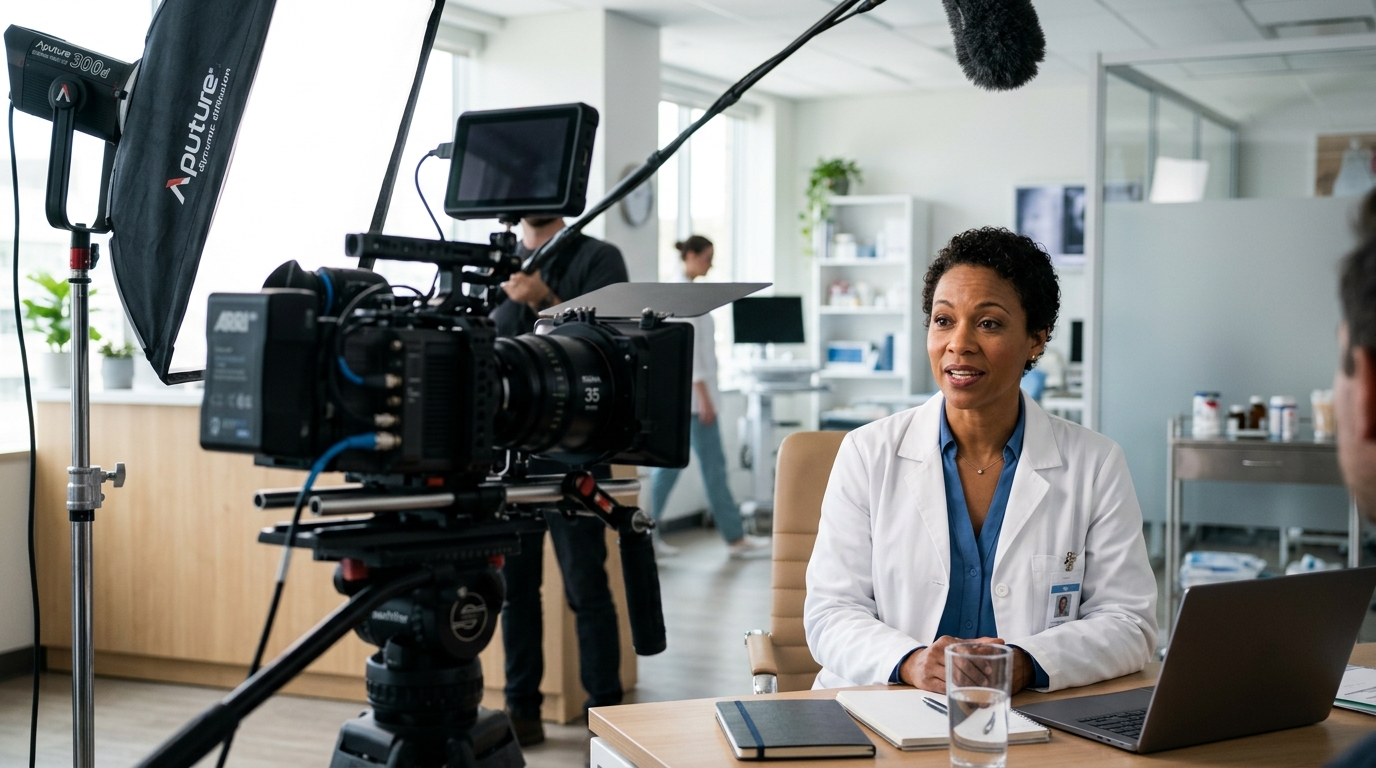
Answer engines are built to be cautious about health information — it is the definition of a “your money or your life” topic, where they lean hard on expertise and trust. That caution is an opening for real providers. A named, credentialed clinician explaining a condition on camera is exactly the kind of verifiable, authoritative source these systems are designed to prefer. You are not competing with a faceless content farm; you are offering the one thing the model is desperate to find — a real expert, on the record. Most stock-footage health channels cannot claim that. You can.
The anatomy of a citable clinician video
A video engineered to be quoted by AI has a recognizable shape. It opens by answering the question in the first fifteen seconds, plainly, the way the clinician would answer a patient — because that clean, self-contained sentence is what an engine lifts. It uses a real question as the title, mirroring how patients actually search. It ships with an accurate, human-checked transcript and a keyword-honest description. It is marked up with VideoObject schema so the machine knows the title, upload date, and thumbnail without guessing. And it names the provider and their credentials on screen and in the metadata, so the engine can attribute the expertise to a verifiable person and organization. That is E-E-A-T rendered in video form.
One production, optimized for every engine
The good news is you do not need a different video for each platform. Google’s AI Overviews already reward YouTube citations heavily. Perplexity favors clearly sourced, well-structured answers — which a transcribed Q&A video delivers cleanly. And while ChatGPT still cites video comparatively rarely today, its video citations are growing fast from a near-zero baseline, meaning the practices building a transcript-rich video library now are staking a claim before that frontier opens. Produce one credible, well-transcribed, properly marked-up clinician video and you have an asset every engine can read. Our healthcare video production is built around that standard from the first day of pre-production.
From a citation to a booked patient
Getting quoted by an AI is not a vanity metric — it is top-of-funnel discovery in the place patients now start. But a citation only pays off if the path from “I saw your clinician explain this” to “I booked an appointment” is deliberate. That means the video points to a matching service page, the service page is itself AEO-optimized, and your analytics can actually connect a video view to an inquiry. Video without that downstream plumbing is brand-building you cannot measure; video with it is a patient-acquisition channel. We tie the two together through healthcare video marketing and training, so your team keeps producing citable video long after the first engagement.
A note on compliance and hosting
Two guardrails keep video AEO safe in healthcare. Keep patient stories consented and privacy-clean — a testimonial is powerful only if it is compliant. And host deliberately: a public YouTube channel is the right home for educational, citable content, while anything touching patient specifics belongs behind the appropriate protections. The wins here come from public-facing education, which keeps the compliance surface small when it is planned from the start.
Frequently asked questions
Does my practice really need YouTube for AI search?
If you want to be cited by Google’s AI Overviews, it is the highest-leverage single move — YouTube is the most-cited domain those overviews pull from. A transcript-rich clinician channel is the most direct way onto that source list.
Do AI engines watch video or read it?
They read it. Answer engines ingest the transcript and treat it like text they can quote, which is why an accurate, human-checked transcript is the difference between a video that gets cited and one that is invisible.
How long should a citable healthcare video be?
Long enough to answer one question well — often just one to three minutes. What matters is that the answer is complete and stated plainly near the top, not the runtime.
Is this different from normal YouTube SEO?
It overlaps but goes further. Classic YouTube SEO optimizes for YouTube’s own search and recommendations; video AEO adds transcript quality, VideoObject schema, question-framed titles, and on-camera credentials so external answer engines will quote you.
What is the fastest way to start?
Pick your ten most-asked patient questions and record a credentialed provider answering one per short video, each with a clean transcript and a real-question title. That single library seeds both YouTube and AI-answer visibility.
Be the source AI quotes
Text-only content strategies are optimizing for a shrinking slice of how patients find care. The most-cited source in AI search is video, and healthcare is the category where a real, named expert on camera carries the most weight. Build a transcript-rich, credential-forward video library now and you become the provider AI reaches for when a patient asks. Explore our AI and AEO capabilities to see how we engineer video to be found, quoted, and booked.
Related reading: The Provider-Led Short-Form Video Formula for Patient Growth.