

Here’s a number that should keep healthcare executives up at night: 68 million.
That’s how many Hispanic Americans live in the United States today. They represent 20% of the total population, wield $2.7 trillion in annual spending power, and are actively searching for healthcare providers who understand them.
Yet walk into most medical practices, and you’ll find English-only websites, English-only marketing, and English-only patient communication systems.
The math is brutal: If your practice serves a community where 20% of residents speak Spanish at home, and your marketing reaches 0% of them effectively, you’re not just leaving money on the table—you’re handing it directly to competitors who figured this out years ago.
This isn’t a diversity initiative. It’s a revenue crisis hiding in plain sight.
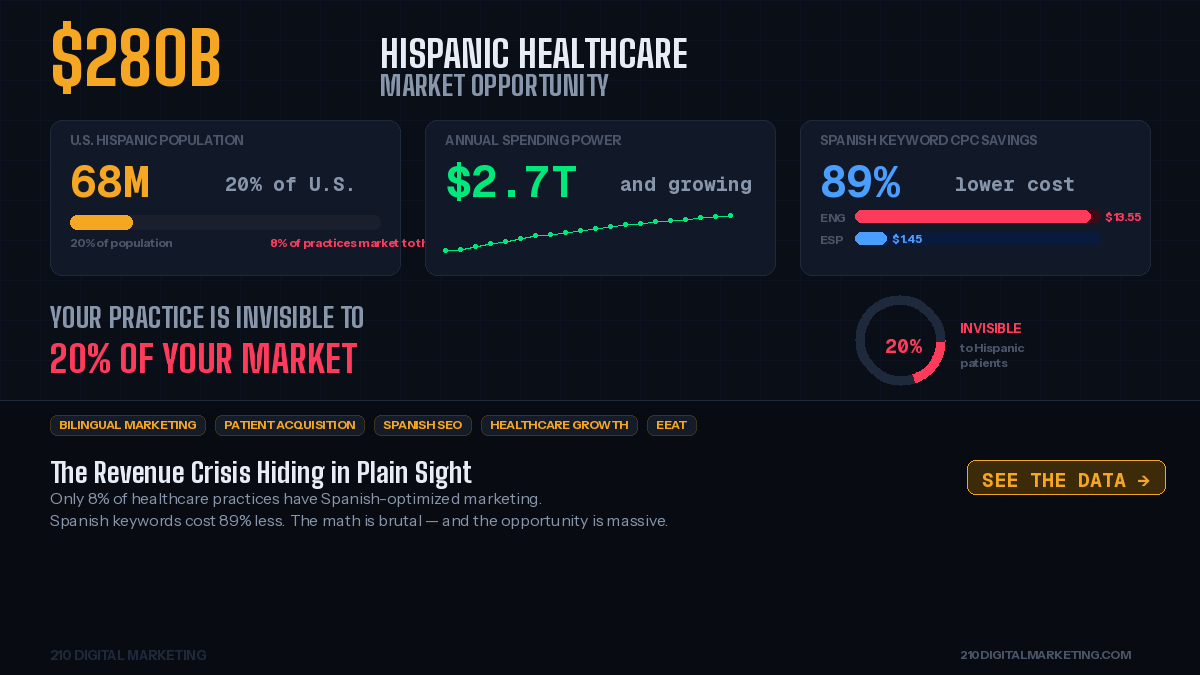
68 million Hispanic Americans wield $2.7 trillion in spending power, yet only 8% of healthcare practices market in Spanish. The revenue gap is massive — and the CPC arbitrage is even bigger.
The Hispanic Healthcare Opportunity: By the Numbers
Before we dive into solutions, let’s establish what we’re actually talking about. The data here isn’t ambiguous—it’s overwhelming.
Population and Economic Power
According to the U.S. Department of Health and Human Services Office of Minority Health, the Hispanic population has become a dominant economic force:
- 68+ million Hispanic/Latino residents in the United States (2024 Census Bureau estimates)
- 20% of the total U.S. population—up from just 7% in 1980
- $4.1 trillion Latino GDP contribution in 2023, according to UCLA’s Latino GDP Report
- $2.7 trillion in direct consumer spending power, per NIQ research
- 30.6% of total U.S. GDP growth from 2019-2023 came from Latino economic activity
To put this in perspective: if U.S. Latinos were a separate country, their economy would rank as the fifth-largest in the world—larger than the United Kingdom, France, or India.
Healthcare-Specific Demographics
The healthcare implications are equally significant. Data from the CDC’s National Center for Health Statistics and Pew Research Center reveal a market with massive unmet needs:
- 17.0% of Hispanics lack health insurance coverage—more than double the national average of 8.2%
- 25.3% of Hispanic adults ages 18-64 were uninsured in 2024
- 68.2% of Hispanics speak a language other than English at home
- 28.7% report speaking English “less than very well”
- Hispanic Americans account for 19% of the U.S. population but only 9% of healthcare practitioners
This gap between population representation and healthcare infrastructure creates both a public health challenge and a market opportunity for practices willing to bridge it.
The Marketing Gap: Where $4.2 Million Disappears
Here’s where theory meets financial reality.
Consider a mid-sized medical practice in a metropolitan area where Hispanic residents comprise 25% of the local population—which describes much of Texas, California, Florida, Arizona, Nevada, and New Jersey.
If that practice generates $5 million in annual revenue from its current patient base, and Hispanic patients are underrepresented by 80% compared to their population share, the practice is effectively invisible to a quarter of its potential market.
Conservative estimate: $1.25 million in unrealized annual revenue from Hispanic patients alone.
More aggressive calculation: If Hispanic patients actually over-index on healthcare spending due to family-centered care decisions and higher rates of chronic conditions requiring ongoing treatment, that number climbs significantly higher.
Why Translation Alone Fails
Most practices that attempt to reach Hispanic patients make a critical error: they translate their existing marketing materials and call it a strategy.
This approach fails for several interconnected reasons:
1. Cultural Health Beliefs Differ Significantly
Hispanic patients often have distinct perspectives on healthcare that affect everything from how they research providers to how they make treatment decisions. Family involvement in healthcare decisions is typically much higher. Trust is built differently—often through community reputation and personal recommendations rather than credentials alone.
2. Search Behavior Varies
Spanish-language searches use different keywords, different phrasing, and different intent signals than English searches. A direct translation of your English SEO strategy won’t capture how Spanish-speaking patients actually look for care.
3. Translation ≠ Transcreation
Effective bilingual marketing requires transcreation—adapting content culturally, not just linguistically. The emotional triggers, trust signals, and persuasion patterns that work in English often fall flat or even backfire when simply translated to Spanish.
4. Channel Preferences Differ
Hispanic consumers are among the most digitally active demographics in the United States. According to NIQ’s multicultural research, they spend more time on streaming platforms and social media than the general population. Marketing strategies need to meet them where they actually are.
The Competitive Reality: First-Mover Advantage Still Exists
Here’s the opportunity hidden within the problem: most healthcare practices haven’t figured this out yet.
While 20% of Americans are Hispanic, our research and industry observation suggests that fewer than 10% of healthcare practices have implemented meaningful Spanish-language marketing strategies. Even fewer have developed truly culturally-adapted patient acquisition systems.
This gap creates a significant first-mover advantage for practices that act now. In digital marketing, being first to dominate a keyword space, build Spanish-language content authority, and establish community presence creates compounding returns that competitors struggle to overcome.
What “Meaningful” Hispanic Marketing Actually Looks Like
Effective bilingual healthcare marketing isn’t a checkbox—it’s a comprehensive patient acquisition architecture. The practices that succeed implement multiple interconnected elements:
Spanish-Language Website Presence
Not a Google Translate overlay, but a professionally developed Spanish-language site experience with culturally appropriate imagery, messaging, and user flows. This includes Spanish-language SEO targeting the actual search terms Hispanic patients use.
Bilingual Content Strategy
Original Spanish-language content that addresses the specific health concerns, questions, and decision-making factors relevant to Hispanic patients. Educational content that demonstrates cultural competence builds trust before the first appointment.
Culturally-Adapted Advertising
Paid media campaigns designed for Hispanic audiences from the ground up—not translated English ads. This includes platform selection, creative development, targeting parameters, and landing page experiences.
Spanish-Language Patient Communication
Appointment reminders, follow-up communications, and patient education materials in Spanish. Practices that can communicate throughout the patient journey in a patient’s preferred language see dramatically higher retention and referral rates.
Community Integration
Presence in Hispanic community events, partnerships with Hispanic-serving organizations, and reputation building within Spanish-language local networks. Word-of-mouth remains extraordinarily powerful in Hispanic communities.
The ROI Case: What Our Clients Actually See
At 210 Digital Marketing, we’ve spent over two decades building patient acquisition systems for healthcare practices. When we implement comprehensive bilingual marketing strategies, the results follow predictable patterns:
Patient Acquisition Costs Drop
Spanish-language keywords and advertising typically face less competition than their English equivalents. Cost-per-click and cost-per-acquisition can run 30-50% lower in Spanish-language campaigns targeting the same services.
Patient Lifetime Value Increases
Hispanic patients who find a practice that communicates in their language and understands their culture tend to stay longer, refer more family members, and comply better with treatment plans. The lifetime value premium often exceeds 40%.
Market Share Gains Accelerate
In markets with significant Hispanic populations, practices that establish bilingual marketing leadership capture disproportionate market share. Competitors who wait find themselves playing catch-up against established Spanish-language content authority.
Exit Multiples Improve
Healthcare practices with diversified, growing patient bases command higher valuations. Practices with established Hispanic market presence demonstrate growth potential that acquirers value—we’ve observed practices with strong bilingual operations trading at 1.2-1.4x higher multiples than comparable single-language practices.
Implementation: Where to Start
If you’re a healthcare executive recognizing the opportunity described here, the question becomes: where do you begin?
Step 1: Audit Your Current State
Before building anything new, understand your baseline:
- What percentage of your patient base is Hispanic? How does this compare to your service area demographics?
- Do you have any Spanish-language web presence? How does it perform?
- What Spanish-language keywords do you currently rank for (if any)?
- Can your front desk and clinical staff communicate in Spanish?
- What do your online reviews say about cultural competence and language accessibility?
Step 2: Quantify the Opportunity
Use publicly available demographic data to calculate your specific market opportunity:
- Pull Census data for your primary and secondary service areas
- Identify Hispanic population percentages by zip code
- Estimate the revenue gap based on your current Hispanic patient percentage versus population share
- Project the lifetime value of closing even 25% of that gap
Step 3: Prioritize Based on Resources
Not every practice can implement a comprehensive bilingual strategy overnight. Prioritize based on impact and feasibility:
Quick Wins (30-60 days):
- Google Business Profile optimization with Spanish-language elements
- Spanish-language Google Ads campaigns for high-intent keywords
- Basic Spanish-language landing pages for top services
Foundation Building (60-180 days):
- Full Spanish-language website development
- Spanish-language content strategy and initial content creation
- Bilingual patient communication systems
Market Leadership (6-18 months):
- Comprehensive Spanish-language SEO and content authority building
- Community integration and partnership development
- Full bilingual patient experience across all touchpoints
The Stakes: What Happens If You Wait
The Hispanic population isn’t static. It’s growing at 1.8% annually—nearly nine times faster than the non-Hispanic population. By 2060, projections suggest Hispanic Americans will comprise 28% of the U.S. population.
Every year you wait:
- Competitors establish stronger Spanish-language content authority
- Spanish-language advertising becomes more competitive (and expensive)
- Community reputation advantages compound for early movers
- The revenue gap between your practice and bilingual competitors widens
The practices that recognize this opportunity today and act on it will own significant market share advantages that compound over decades. The practices that wait will find themselves competing for an increasingly expensive, crowded space.
The Bottom Line
The Hispanic healthcare marketing opportunity isn’t theoretical. It’s 68 million people, $2.7 trillion in spending power, and a healthcare system that largely ignores them.
For healthcare practices willing to invest in genuine bilingual patient acquisition—not just translated brochures—the returns are substantial, sustainable, and increasingly rare in a commoditized healthcare market.
The question isn’t whether Hispanic healthcare marketing works. The question is whether you’ll capture your share of this market before your competitors do.
Frequently Asked Questions
What percentage of the US population is Hispanic?
According to the U.S. Census Bureau’s 2024 American Community Survey, more than 68 million Hispanics/Latinos live in the United States, representing approximately 20% of the total U.S. population. This makes Hispanics the nation’s second-largest racial or ethnic group after non-Hispanic whites.
What is the buying power of Hispanic consumers in the US?
Hispanic consumers wield approximately $2.7 trillion in spending power, according to NIQ research published in 2025. The U.S. Latino GDP reached $4.1 trillion in 2023—equivalent to the fifth-largest economy in the world if considered separately—according to the UCLA Center for the Study of Latino Health and Culture.
Why do healthcare practices struggle to reach Hispanic patients?
Most healthcare practices fail to implement culturally-adapted marketing strategies. Simple translation is insufficient—effective Hispanic healthcare marketing requires transcreation that accounts for cultural health beliefs, family decision-making dynamics, trust-building preferences unique to Hispanic communities, and different digital behavior patterns.
What is the Hispanic uninsured rate compared to the national average?
According to the Office of Minority Health, 17.0% of Hispanics/Latinos had no health insurance coverage in 2024, compared to 8.2% of the total U.S. population. Hispanics have the highest uninsured rate of any racial or ethnic group in the United States, creating both challenges and opportunities for healthcare providers.
How can healthcare practices effectively market to Hispanic patients?
Effective Hispanic healthcare marketing requires a comprehensive approach including: professionally developed Spanish-language website presence (not machine translation), original Spanish-language content addressing Hispanic patient concerns, culturally-adapted advertising campaigns, bilingual patient communication systems, and community integration within Hispanic networks.
Sources and References
- U.S. Department of Health and Human Services, Office of Minority Health. “Hispanic/Latino Health.” https://minorityhealth.hhs.gov/hispaniclatino-health
- UCLA Latino Policy & Politics Institute and Cal Lutheran Center for Economic Research and Forecasting. “2025 U.S. Latino GDP Report.” https://newsroom.ucla.edu/releases/us-latino-gdp
- NIQ (NielsenIQ). “Multicultural Momentum: How Hispanic Consumers Are Redefining Retail Growth.” September 2025. https://nielseniq.com/global/en/insights/report/2025/hispanic-consumers-redefining-retail/
- Pew Research Center. “5 facts about Hispanic Americans and health care.” October 2023. https://www.pewresearch.org/short-reads/2023/10/30/5-facts-about-hispanic-americans-and-health-care/
- Centers for Disease Control and Prevention, National Center for Health Statistics. “FastStats – Health of Hispanic or Latino Population.” https://www.cdc.gov/nchs/fastats/hispanic-health.htm
- U.S. Census Bureau. “Health Insurance Coverage in the United States: 2024.” https://www.census.gov/library/publications/2025/demo/p60-288.html
- ASPE (Office of the Assistant Secretary for Planning and Evaluation). “Health Coverage and Access Among Latinos.” June 2024. ASPE Issue Brief HP-2024-12
210 Digital Marketing is a healthcare-focused digital marketing agency with over 22 years of experience building patient acquisition systems for medical practices. Our bilingual team specializes in culturally-adapted marketing strategies that capture the Hispanic healthcare market opportunity. Schedule a consultation to discuss your practice’s growth potential.
