
Your Competitors Are Already Using AI for Marketing — Here’s How to Catch Up
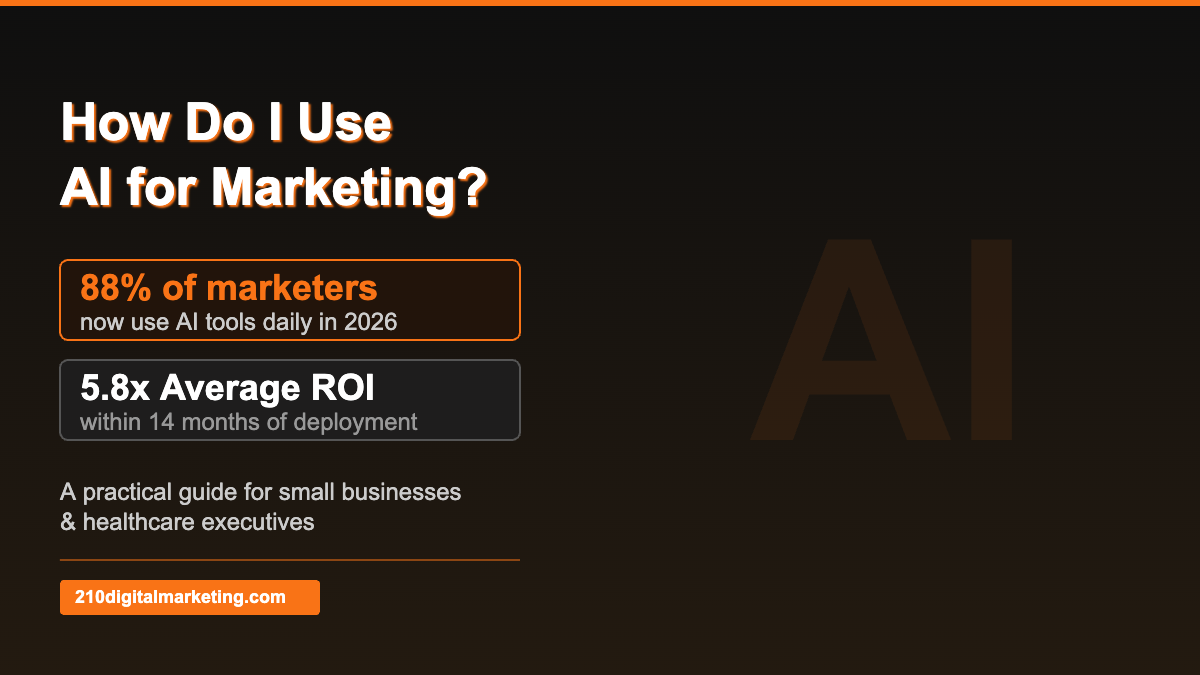
If you’re a small business owner or healthcare executive staring at the words “AI marketing” and feeling like you’ve already fallen behind — take a breath. 88% of marketers now use AI tools daily in 2026, according to industry data, but the truth is most of them are barely scratching the surface.
The real question isn’t whether you should use AI for marketing. It’s how to use it without wasting money, losing your brand’s voice, or turning your audience off with content that feels robotic.
Let’s walk through it — practically, honestly, and without the hype.
What Can AI Actually Do for Your Marketing Right Now?
AI isn’t one tool — it’s a category of tools that handle different jobs. Think of it like hiring a team, not a single employee. Here’s what the leading platforms bring to the table:
ChatGPT (OpenAI) is the Swiss army knife. It handles the widest range of tasks — idea generation, email drafts, blog outlines, social captions, even basic SEO meta tags. It’s not the best at any single thing, but it rarely forces you to switch tools. The catch? It still hallucinates facts and can rehash the same point across long-form content, so human review isn’t optional.
Claude (Anthropic) excels at long-form content and nuanced writing. With a massive context window, it maintains coherence across comprehensive guides and whitepapers better than competitors. It’s also built with a focus on reduced hallucination rates. The tradeoff is it can sometimes over-filter content it deems risky, which means you may need to push it on edgier marketing angles.
Gemini (Google) stands out for one thing most LLMs treat as an afterthought: video. Gemini handles video generation and editing in ways that feel production-ready, and its million-token context window makes it a powerhouse for deep research and large document analysis. Where it falls short is creative marketing copy — it’s more analyst than artist.
The evidence-based takeaway? No single AI excels at everything. The marketers seeing the best results in 2026 are combining two or three platforms — using each where it’s strongest.
Why Video Should Be at the Center of Your AI Marketing Strategy
Here’s the stat that should reshape your entire content calendar: 90% of marketers credit video with delivering a positive ROI, and short-form videos under 60 seconds are the highest-performing format across every platform.
For small businesses, the economics have fundamentally shifted. What cost $10,000 to produce two years ago now costs $500. What took two weeks takes two hours. AI-powered editing tools, automated captions, and template-based production mean every business — regardless of size — can now compete with video.
For healthcare practices specifically, video creates transparency that shortens the credibility gap with prospective patients. A 30-second walkthrough of your facility, a physician answering a common question on camera, a patient testimonial — these outperform any written blog post or paid ad in building trust.
Companies using video generate 41% more web traffic from search than those that don’t. Adding video to a landing page can increase conversions by up to 80%. If you’re investing in AI marketing and not prioritizing video, you’re optimizing the wrong channel.
The AI Video Trap: When Artificial Looks Artificial
Here’s where it gets nuanced — and where too many businesses are getting burned.
Nearly 78% of consumers say they trust videos featuring real people over AI-generated content. That’s not a small preference gap — it’s a chasm. Among consumers who’ve watched videos they believe were AI-generated, 36% say it actively lowers their trust in the brand behind it.
The giveaways are obvious to viewers: robotic gestures (cited by 67% of consumers), unnatural voices (55%), and a total lack of emotional tone (51%). One-third of all customers say they’ll stop interacting with a brand entirely if they discover the content is AI-generated rather than human-made.
So what’s the move? Use AI to produce and edit video — not to replace the humans in it. Let AI handle scripting, captioning, editing, thumbnail creation, and distribution optimization. But keep real people on camera. That’s where trust lives.
When AI Helps — and When It Can Hurt You
AI is exceptional at:
Tasks Where AI Delivers Immediate Value
Drafting and iteration. First drafts of blog posts, email sequences, ad copy variations, social captions — AI gets you 70% of the way in 10% of the time. This is where the ROI is clearest. AI campaigns deliver 22% better ROI, 32% more conversions, and 29% lower acquisition costs than traditional methods.
Research and analysis. Summarizing competitor content, analyzing keyword gaps, pulling market data, and synthesizing industry reports. Gemini’s deep context window makes this especially powerful for healthcare executives processing regulatory updates or market research. (See also: The Healthcare Executive’s Guide to AI in 2026).
Repurposing content across channels. Turn a blog post into 10 social posts, an email sequence, and a video script. AI makes multichannel marketing economically viable for businesses that previously couldn’t afford it.
Tasks Where AI Will Hurt More Than Help
Brand voice and originality. AI trained on the entire internet produces content that sounds like the entire internet. If your marketing reads like everyone else’s, you’ve paid for invisibility. This is where your expertise matters — feeding AI your brand guidelines, past successful content, and specific tone examples transforms generic output into something distinctly yours.
Cultural nuance and local market knowledge. AI doesn’t understand that your San Antonio patient base responds differently than a Los Angeles audience. It doesn’t know the cultural context of your bilingual community. Human expertise isn’t just a nice-to-have — it’s the quality filter between content that converts and content that gets ignored.
Sensitive healthcare communications. Patient testimonials, treatment descriptions, compliance-sensitive claims — these require human judgment, period. AI can draft, but a human must review, especially in healthcare where HIPAA compliance and medical accuracy aren’t negotiable.
The Pre-Training Advantage: Why Your Original Content Is Now Your Biggest Asset
Here’s the opportunity most small businesses and healthcare practices are completely missing.
In 2026, Google’s ranking algorithms prioritize human oversight combined with AI efficiency, penalizing purely automated, low-quality content. The businesses winning aren’t the ones publishing the most AI content — they’re the ones feeding AI with the best original content.
The practice is called pre-training or fine-tuning: you feed AI models your brand voice documentation, past blog posts, successful social media captions, and customer-facing scripts. The AI then produces content that sounds like you, not like a template.
This is where expertise becomes your moat. A healthcare practice with 10 years of patient education content has a training dataset no competitor can replicate. A small business owner who’s documented their process, their story, their unique approach to customer service — that’s proprietary data that makes AI output genuinely original.
The marketers seeing 280-520% annual ROI on AI investments aren’t using AI out of the box. They’re investing the upfront work to make AI an extension of their existing expertise.
A Practical Roadmap: Implementing AI Marketing Without the Overwhelm
1. Start With One Platform, One Use Case
Don’t try to overhaul everything at once. Pick one AI tool — ChatGPT is the easiest starting point — and use it for one specific task, like drafting weekly social media posts or generating email subject lines. Master that workflow before expanding.
2. Build Your Content Library First
Before asking AI to create, give it something to learn from. Compile your best-performing blog posts, your brand voice guide, examples of emails that got high open rates. This is your training data — and it’s more valuable than any premium subscription.
3. Prioritize Video — With Real People
Use AI for video editing, captioning, and repurposing — but get a real person on camera. Even a smartphone video of a physician answering a patient FAQ will outperform a polished AI avatar. Authenticity converts. AI polish supports it.
4. Set a Human Review Gate
Every piece of AI-generated content gets reviewed by a human before publishing. No exceptions. This is especially critical in healthcare, where inaccurate claims carry legal and reputational consequences.
5. Measure What Matters
Track the metrics that matter: conversion rates, patient acquisition cost, engagement rates on video versus static content. Marketing teams using AI report 40% time savings and 3x content output — but only when they’re measuring outcomes, not just output volume.
The Bottom Line: AI Is the Tool, You’re the Strategy
AI has democratized marketing in ways that genuinely benefit small businesses and healthcare practices. The cost barriers are gone. The production speed is there. The technology is mature enough to deliver real ROI — with average returns of 5.8x within 14 months of deployment.
But the businesses that will win aren’t the ones that automate the most. They’re the ones that combine AI efficiency with human expertise, original content, and — above all — authentic video featuring real people telling real stories.
The consumers have spoken: they trust humans. They’re skeptical of AI-generated content. And they’re watching more video than ever before. Your strategy should reflect all three of those realities.
If you’re ready to implement AI marketing the right way — with strategy, not just software — 210 Digital Marketing specializes in helping healthcare practices and small businesses build AI-powered marketing systems that actually generate patients and revenue, not just pageviews.
Schedule a free consultation and let’s build an AI marketing strategy that’s built on your expertise, your voice, and the video content your audience actually wants to see.
