

I Tested Every Major AI Content Creation Tool — Here’s What Actually Works
Six months ago, a dermatology practice in San Antonio asked us a question that stopped me in my tracks: “We’re creating more content than ever, but our patient inquiries dropped 30%. What are we doing wrong?”
The answer was hiding in plain sight. They’d gone all-in on AI-generated content — blogs, social posts, video scripts, email campaigns — and every single piece sounded exactly like everyone else’s AI-generated content. Their audience could feel the difference, even if they couldn’t name it.
That experience sent me on a six-month deep dive into every major AI content creation tool on the market. Not to rank features or compare pricing tiers, but to answer the only question that matters: which tools help you create content that actually sounds like you?
The Content Creation Crisis Nobody Talks About
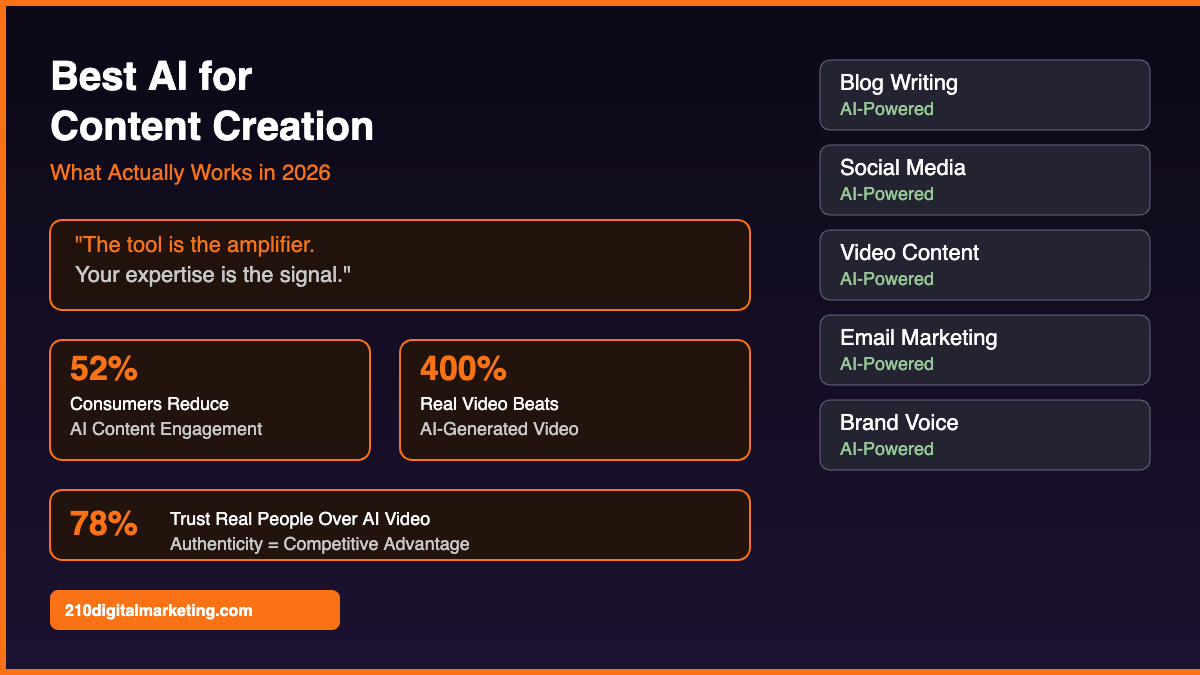
Here’s what the industry doesn’t want to admit: 52% of consumers actively reduce engagement when they suspect content is AI-generated. (AllAboutAI) That’s not a theoretical concern — it’s a measurable business problem happening right now — one that’s already breaking healthcare sales funnels to small businesses and healthcare practices across the country.
At the same time, 88% of marketers use AI tools daily (HubSpot) and the ones doing it well are seeing extraordinary results — 40% time savings, 3x content output, and ROI averaging 5.8x within 14 months. The gap between “doing AI content well” and “doing AI content badly” has never been wider.
The difference? It comes down to choosing the right tool for the right job (see our complete guide on how to use AI for marketing) — and understanding that the tool is only as good as what you feed it.
The Writing Tools: Where Words Come From Matters
ChatGPT — Your Fastest First Draft
I’ll tell you a story about ChatGPT that explains everything you need to know. A physical therapy clinic needed 12 social media posts per week. Their marketing person was spending 15 hours creating them manually. We set up ChatGPT with their brand voice guide, their most-liked past posts as examples, and a simple template system.
Result? Those 15 hours dropped to 3. The posts needed human editing — every single one — but the starting point was solid enough that the editing felt like polishing, not rewriting.
Where ChatGPT shines for content creation: Social media captions, email subject lines, blog outlines, content calendars, and brainstorming sessions. It’s the fastest tool for generating volume, and for small businesses that need to show up consistently across channels, speed matters.
Where it falls apart: Long-form content. Anything beyond 800 words starts repeating itself, losing its thread, or drifting into that unmistakable “AI voice” that readers have learned to detect. And it fabricates statistics — I’ve caught it inventing studies that don’t exist, which in healthcare content isn’t just embarrassing, it’s dangerous.
Claude — The Content Strategist’s Secret Weapon
Claude changed how I think about AI content creation. Here’s why: I fed it a 40-page brand voice guide for a behavioral health center, along with 20 of their best-performing blog posts and their patient FAQ document. Then I asked it to write a 2,000-word article on medication-assisted treatment.
The first draft read like a clinician wrote it — accurate, empathetic, and structurally sound. Not perfect, but the kind of first draft that a skilled editor can turn into a published piece in 30 minutes instead of 3 hours.
Claude’s massive context window is the reason. It holds your entire brand identity in memory during a single session — your voice, your terminology, your clinical boundaries — and produces content that stays consistent from first paragraph to last. For healthcare content where accuracy and empathy both matter, this is transformative.
The catch: Claude can be overly cautious with healthcare topics. It sometimes softens claims that are perfectly accurate and compliant because its safety filters are conservative. You’ll occasionally need to push back and say “this is medically accepted terminology, use it.”
Gemini — When Research Drives the Content
Gemini earned its place in our content workflow for one specific reason: it processes massive amounts of research material and synthesizes it better than any other LLM. When a client needs a thought leadership piece backed by recent data — industry trends, regulatory updates, market analysis — Gemini is where I start.
Its million-token context window means I can feed it an entire quarter’s worth of industry publications and get back a nuanced, well-sourced content outline that would take a human researcher days to compile.
The limitation for content creators: Gemini writes like a brilliant analyst who’s never taken a creative writing class. The information is excellent; the prose is forgettable. I use Gemini for research and outlines, then write (or rewrite) the actual content with a different tool or by hand.
The Video Content Revolution — And Its Biggest Pitfall
Let me share the most important content creation statistic of 2026: 85% of consumers say video directly influenced a purchase decision (Loopex Digital), and short-form video delivers the highest ROI of any content format. Period. (The numbers are staggering — see our Healthcare Video Marketing Stats.)
The tools have caught up to the demand. Opus Clip turns a single long-form video into dozens of platform-optimized short clips. Pictory converts written content into video in minutes. Canva’s Magic Studio handles everything from social graphics to animated presentations. Descript makes editing audio and video as simple as editing a text document.
But here’s the story that should reshape your entire video strategy.
A dental practice in our network invested $3,000 in AI-generated video content — synthetic presenter, AI voiceover, automated editing. Professional-looking stuff. In the same month, they shot five smartphone videos of their lead dentist answering common patient questions. No script, no production value, just a real person talking to the camera for 60 seconds.
The smartphone videos outperformed the AI videos by 400% in engagement. And the data backs this up universally: 78% of consumers trust videos featuring real people over AI-generated content. (StudyFinds) Among those who identify AI-generated video, 36% report lower brand trust as a direct result.
The lesson every content creator needs to learn: use AI to produce and edit video — scripting, captioning, cutting, optimizing — but never to replace the human in front of the camera. Authenticity isn’t a marketing buzzword. In 2026, it’s a measurable competitive advantage.
The Pre-Training Secret: Why Your Best Content Already Exists
Here’s the story that changed everything for our content strategy.
We had a client — an orthopedic surgery practice — with seven years of patient education blog posts, procedure guides, and recovery FAQs. They wanted to “start fresh with AI.” I convinced them to do something different: we fed every piece of their existing content into Claude as training context before generating a single new word.
The result was like watching a junior writer suddenly channel the voice of their most experienced physician. The AI output didn’t just sound professional — it sounded like their practice. Their specific terminology, their particular way of explaining complex procedures, their compassionate-but-direct tone.
The content creators seeing 280-520% annual ROI on AI investments (Distrya) all share this approach. They treat their existing content as a training dataset, not an archive to replace. Google’s 2026 algorithms reward this — human expertise combined with AI efficiency ranks higher than pure AI output or pure human output alone.
For small businesses and healthcare practices, this is the single biggest opportunity in AI content creation right now. Your years of expertise, your documented processes, your patient education materials — that’s proprietary training data that no competitor can replicate.
When AI Content Creation Helps — And When It Actively Hurts Your Brand
Use AI Aggressively For
Content repurposing. One well-written blog post becomes 10 social posts, 3 email snippets, a video script, and a newsletter section. This is where AI content creation delivers its most undeniable ROI — making your best content work harder across every channel.
First drafts and ideation. AI eliminates the blank page. Even when the first draft needs heavy editing, starting from something is always faster than starting from nothing. The time savings here are real: teams report 40% reduction in content creation time.
Consistency at scale. If you’re managing content across multiple locations, multiple platforms, or multiple team members, AI tools like Jasper maintain brand voice consistency that’s nearly impossible to achieve manually.
Never Use AI For
Final published content without human review. Every piece of AI-generated content needs human eyes before it reaches your audience. This is non-negotiable, and it’s especially critical for healthcare practices where inaccurate claims carry legal consequences.
Replacing human faces in video. The consumer trust data is overwhelming and definitive. AI-generated presenters, synthetic voices, and avatar-based video content actively damage brand trust. Keep real people on camera — always.
Sensitive patient or customer communications. Treatment descriptions, testimonials, compliance-sensitive messaging — these require human judgment that AI cannot replicate. AI can help draft, but a human must own the final version.
Building Your Content Creation Workflow
After testing every major tool, here’s the workflow I recommend for small businesses and healthcare practices:
Step 1: Build Your Training Library
Before touching any AI tool, compile your best-performing content, your brand voice guide, and any documentation that captures how your business actually communicates. This is your foundation — and it’s more valuable than any subscription.
Step 2: Choose Your Core Writing Tool
Claude for long-form content requiring accuracy and nuance. ChatGPT for high-volume short-form content. Gemini for research-heavy pieces. Most businesses need two of these three.
Step 3: Invest in Video — With Real People
Use AI for editing, captioning, and distribution (Opus Clip, Descript, CapCut). But put a real human on camera. Even 60-second smartphone videos of your team answering common questions will outperform any AI-generated alternative.
Step 4: Establish a Human Review Gate
No content publishes without human review. No exceptions. The 30 minutes you invest in editing saves you from the trust erosion that comes with obviously AI-generated content.
The Real Secret to AI Content Creation
After six months of testing, here’s what I know for certain: the best AI content creation tool is whichever one you’ve taken the time to train with your own expertise. The tool is the amplifier. Your knowledge, your voice, your experience — that’s the signal.
The businesses winning at AI content creation in 2026 aren’t the ones using the fanciest tools. They’re the ones who understood that AI doesn’t replace expertise — it scales it.
If you’re ready to build an AI content creation system that sounds like your business — not like everyone else’s chatbot — 210 Digital Marketing helps healthcare practices and small businesses build content workflows that combine AI efficiency with the authentic voice your audience actually trusts.
Schedule a free consultation and let’s turn your existing expertise into a content engine that your competitors can’t replicate.
