
The Best AI Tools for Marketing in 2026 — Ranked by What Actually Moves the Needle
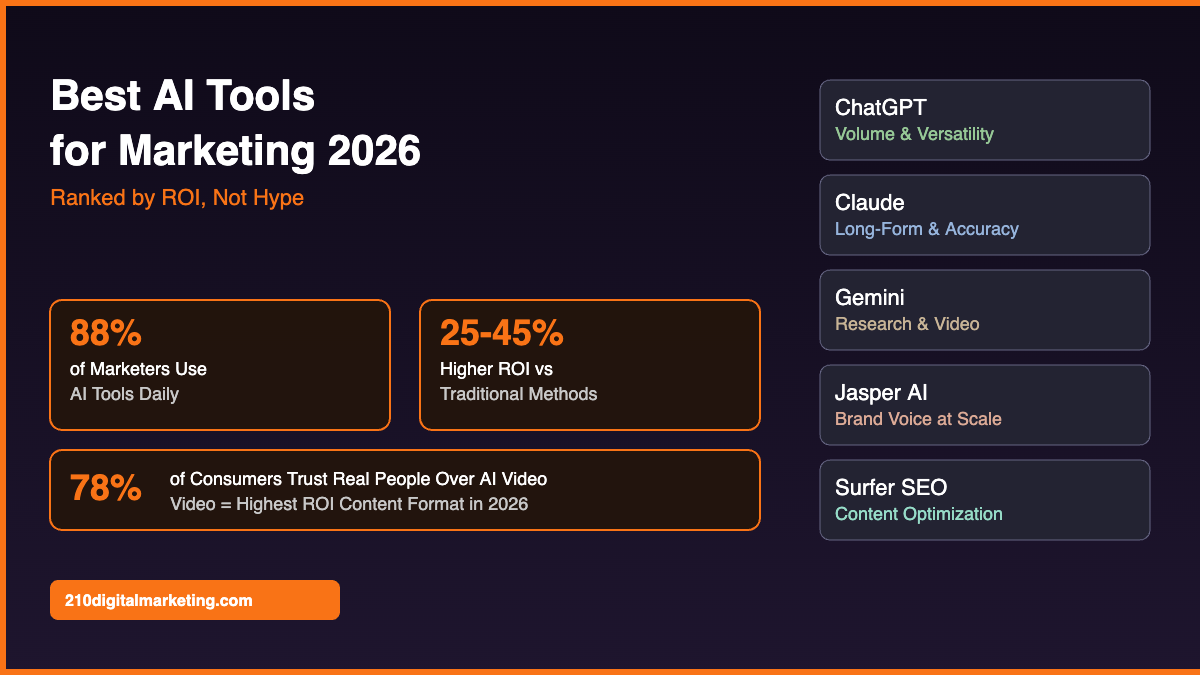
The data is unambiguous: 88% of marketers now use AI tools daily (HubSpot 2026 Marketing Statistics), and marketing teams that deploy AI report 25-45% higher ROI than those relying on traditional methods alone. But here’s the number that should concern you — the average marketer now juggles 6-8 AI tools, and most can’t tell you which ones are actually driving results.

This isn’t a listicle of every shiny platform with a chatbot. This is a data-backed breakdown of the AI marketing tools that deliver measurable returns for small businesses and healthcare organizations in 2026 — and 210 Digital Marketing has tested them all — ranked by ROI, not hype.
What Does the AI Marketing Tool Landscape Actually Look Like?
The market has matured significantly. 68% of US small businesses now use AI regularly, up from 40% just two years ago. Healthcare isn’t far behind — 85% of healthcare leaders are exploring or have already adopted generative AI (NVIDIA Healthcare AI Survey), with 64% reporting quantified positive ROI.
But maturity hasn’t meant simplicity. There are now over 2,000 AI marketing tools available, and 31% of vendors use hybrid pricing models combining seat licenses with usage-based credits. The total cost of ownership is deliberately opaque. That’s why ranking by actual output quality and measurable business impact matters more than feature lists.
The tools below are organized by the marketing function they serve best — because the right tool depends entirely on what you’re trying to accomplish. (For a broader look at implementing AI marketing, see our guide on how to use AI for marketing.).
Tier 1: The General-Purpose LLMs Every Marketer Needs
ChatGPT (OpenAI) — The Volume Workhorse
Best for: First drafts, brainstorming, social media captions, email sequences, ad copy variations, and rapid content repurposing across channels.
ChatGPT remains the most versatile entry point. It handles the widest range of marketing tasks without forcing you to switch platforms — from ideation to execution. The GPT-4o model delivers noticeably better marketing copy than its predecessors, with improved ability to maintain brand voice across long sessions.
The limitation: It still hallucinates statistics, recycles phrasing across long-form content, and produces output that reads like “AI wrote this” without careful prompting. For small businesses, the free tier gets you started, but the $20/month Plus plan is where the real utility begins.
Claude (Anthropic) — The Long-Form Strategist
Best for: Comprehensive guides, whitepapers, healthcare content requiring accuracy, brand voice documentation, and strategic planning documents.
Claude’s massive context window is its defining advantage. It maintains coherence across 50,000+ word documents where other models lose the thread after 3,000. For healthcare marketing specifically, Claude’s reduced hallucination rate makes it the safer choice for patient-facing content where medical accuracy matters.
The limitation: It can over-filter content it deems sensitive — which in healthcare marketing means you may need to push it on claims that are perfectly compliant but sound aggressive. It’s also less effective at punchy, short-form ad copy compared to ChatGPT.
Gemini (Google) — The Research and Video Powerhouse
Best for: Deep market research, competitive analysis, video content strategy, processing large datasets, and leveraging Google’s ecosystem for SEO insights.
Gemini’s million-token context window makes it unmatched for research-heavy marketing tasks. Feed it an entire quarter’s worth of analytics data, competitor content, and industry reports — it synthesizes patterns that would take a human analyst days. Its native video capabilities are the most production-ready of any general-purpose LLM.
The limitation: Creative marketing copy is its weakness. Gemini writes like an analyst, not a marketer — technically accurate but emotionally flat. Use it for research and video, not for your email subject lines.
Tier 2: Specialized Marketing Platforms That Justify Their Price
Jasper AI — Brand Voice at Scale
Jasper’s IQ engine learns your brand voice from examples and style guides, then produces content that actually sounds like your company wrote it. For organizations running multi-channel campaigns — blog posts, social, email, ads — Jasper delivers the consistency that general-purpose LLMs struggle with. Starting around $49/month for individual plans, it pays for itself if you’re producing more than 10 pieces of content per week.
Surfer SEO — Content Optimization That Ranks
Surfer has become the industry standard for on-page content optimization. It analyzes top-ranking pages for your target keywords and provides real-time scoring as you write. The data shows that Surfer-optimized content ranks 68% faster than content written without optimization guidance. For healthcare practices competing in local search, this is the difference between page one and page three.
Cometly — Marketing Attribution That Actually Works
If you’re spending money on ads and can’t tell which campaigns drive revenue versus which drive clicks, Cometly solves that problem. It tracks the complete customer journey from ad click to revenue using AI-powered attribution. For healthcare practices running multi-channel campaigns across Google, Meta, and local directories, knowing your true cost per patient acquisition changes every budget decision.
Why Video Tools Should Be Your Highest Priority Investment
Here’s the data point that should redirect your budget: 85% of consumers say video has directly influenced their purchase decisions, and short-form video delivers the highest ROI of any content format in 2026. Yet most small businesses are still under-investing in video relative to its return.
75% of marketers now use AI for video and image creation. The production cost barrier is gone. What used to require a $10,000 production budget now costs $500 with AI-assisted editing, automated captioning, and template-based workflows.
But here’s where the data gets critical: 78% of consumers trust videos featuring real people over AI-generated content. (StudyFinds Research) Among viewers who identify AI-generated video, 36% report lower brand trust as a direct result. The giveaways are measurable — 67% cite robotic gestures, 55% flag unnatural voices, and 51% notice the absence of emotional tone.
The optimal strategy is clear from the numbers: use AI tools for video editing, captioning, scripting, and distribution — but keep real humans on camera. The ROI data supports this hybrid approach overwhelmingly.
For healthcare practices, this means a physician answering patient FAQs on camera (backed by the data in our Healthcare Video Marketing Stats report), edited and captioned by AI, will outperform any AI avatar or text-based content by a factor of 3-5x in engagement metrics.
The Pre-Training Advantage: When Your Existing Content Becomes Your Competitive Moat
The marketers reporting 280-520% annual ROI on AI investments share one trait: they don’t use AI tools out of the box. They pre-train or fine-tune with their own proprietary content — brand voice guides, historical blog posts, high-performing email copy, and customer interaction scripts.
This matters because Google’s 2026 algorithms penalize purely automated, low-quality content while rewarding content that demonstrates human expertise and oversight. The businesses winning in search aren’t publishing the most AI content — they’re publishing the best AI-assisted content.
For a healthcare practice with a decade of patient education materials, that archive is a training dataset no competitor can replicate. For a small business owner who’s documented their unique methodology, that’s proprietary data that transforms generic AI output into something genuinely original.
The tool matters less than what you feed it. A $20/month ChatGPT subscription pre-trained with excellent source material will outperform a $200/month platform running on default settings every time.
When AI Tools Help — and When They Create More Problems Than They Solve
High-ROI Applications (Use AI Aggressively)
Content repurposing: Turn one blog post into 10 social posts, an email sequence, and a video script. AI makes multichannel marketing viable for businesses that previously couldn’t afford it. Marketing teams report 40% time savings and 3x content output with this approach.
Data analysis and reporting: Gemini and ChatGPT can process a quarter’s worth of campaign data and identify patterns in minutes. For small businesses without dedicated analysts, this is transformative.
A/B testing at scale: Generate 20 subject line variations, 10 ad copy alternatives, and 5 landing page headlines in the time it takes to write two manually. Let the data pick the winner.
Negative-ROI Applications (Proceed With Extreme Caution)
Fully automated content publishing: 52% of consumers reduce engagement when they suspect AI-generated content. (AllAboutAI Marketing Statistics) Publishing without human review doesn’t save time — it costs trust.
AI-generated video with synthetic presenters: The consumer backlash data is definitive. One-third of consumers say they’ll stop interacting with a brand entirely if they discover the content features AI-generated people rather than real humans.
Healthcare compliance content: HIPAA-sensitive communications, treatment claims, and patient testimonials require human judgment. AI can draft, but human review is non-negotiable — the legal and reputational cost of a compliance failure far exceeds any efficiency gain.
Building Your AI Marketing Stack: A Data-Driven Recommendation
Based on ROI data across small business and healthcare verticals, here’s the stack that delivers the most measurable impact per dollar spent:
Essential Stack ($70-120/month)
One general-purpose LLM (ChatGPT Plus or Claude Pro) for content creation and strategy. Surfer SEO for content optimization. A video editing tool with AI captioning (CapCut or Descript). Total investment: approximately $70-120/month with an expected ROI of 3-5x within 90 days.
Growth Stack ($200-400/month)
Add Jasper AI for brand voice consistency across channels. Add Cometly or similar attribution platform for ad spend optimization. Add an AI-powered email platform (ActiveCampaign or HubSpot Starter). This stack is appropriate once you’re producing 15+ pieces of content per week and running paid campaigns.
Enterprise Healthcare Stack ($500-1,000/month)
All of the above, plus compliance review tools, multi-location content management, and patient journey attribution. For healthcare C-suite executives (see also: The Healthcare Executive’s Guide to AI in 2026), the question isn’t whether to invest — it’s whether the $500-2,000/month in savings and 20+ hours reclaimed justify the subscription costs. The data says yes, overwhelmingly.
The Bottom Line: Let the Numbers Guide Your Choices
The AI marketing tool landscape in 2026 is crowded, expensive, and deliberately confusing. But the data cuts through the noise: 83% of marketing teams report clear ROI from GenAI tools (TheRankMasters AI Marketing Benchmarks), with the highest returns coming from businesses that combine AI efficiency with human expertise and — above all — authentic video featuring real people.
Don’t buy tools because they’re trending. Buy them because the ROI data in your specific vertical supports the investment. Start with one platform, pre-train it with your best content, and measure outcomes before scaling.
If you want a data-driven assessment of which AI marketing tools will deliver the highest ROI for your specific business or healthcare practice, 210 Digital Marketing builds custom AI marketing stacks based on your market, your budget, and your growth targets — not generic recommendations.
Schedule a consultation and let’s run the numbers on what AI marketing should actually look like for your organization.
By Jace A.
